
Artificial intelligence doesn’t just respond to prompts — it reasons through them. As AI tools become smarter, how you prompt them increasingly determines the quality of the output.
Modern prompting has evolved far beyond basic instructions. Today, advanced users rely on structured strategies like Chain-of-Thought (CoT) and Tree-of-Thought (ToT) to guide how AI thinks, not just what it answers.
If you’re new to advanced prompting patterns, this guide builds on ideas explained in our deep dive on
👉 5 Advanced Prompt Patterns for Better AI Outputs
Let’s break down when to use Chain-of-Thought vs Tree-of-Thought — and why choosing the right one matters.
What Is Chain-of-Thought Prompting?
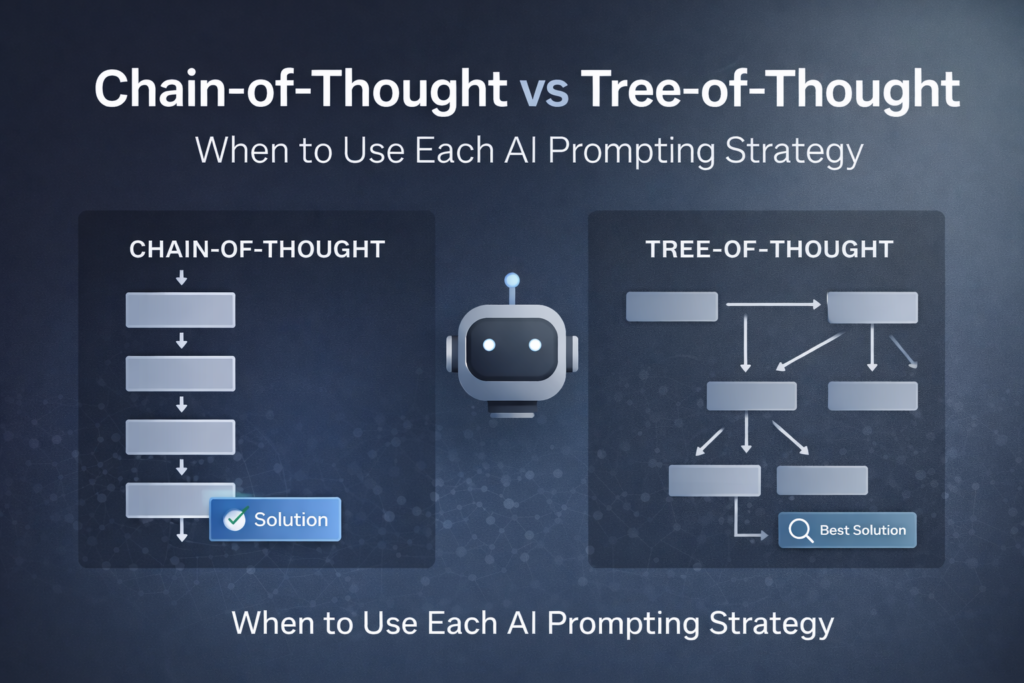
Chain-of-Thought prompting encourages an AI model to reason step by step, following a single logical sequence from start to finish.
Instead of jumping directly to an answer, the model explains how it arrives there.
How Chain-of-Thought Works
When prompted correctly, the AI:
- Breaks the problem into smaller steps
- Solves each step sequentially
- Builds toward a final, logical conclusion
Common trigger phrases include:
- “Think step by step”
- “Explain your reasoning”
- “Show how you arrived at the solution”
This approach aligns closely with custom system prompts, where you define how the model should behave and reason. If you want precision and consistency, pairing Chain-of-Thought with well-designed system prompts is powerful.
👉 Learn how to do that here:
From Generic to Expert: How to Build Custom System Prompts for Precision AI
Best Use Cases for Chain-of-Thought
Chain-of-Thought is ideal when:
- There is one correct or optimal answer
- The task follows a clear logical sequence
- Accuracy and explainability matter
Examples
- Math and logic problems
- Step-by-step tutorials
- Rule-based decisions
- Analytical explanations
Why it works:
By forcing linear reasoning, Chain-of-Thought reduces hallucinations and improves reliability — especially for structured tasks.
What Is Tree-of-Thought Prompting?
Tree-of-Thought prompting allows the AI to explore multiple reasoning paths simultaneously, evaluate them, and then select or refine the best solution.
Instead of a straight line, reasoning branches out like a tree
How Tree-of-Thought Works
The model:
- Generates multiple possible approaches
- Evaluates each option independently
- Compares trade-offs and outcomes
- Chooses the strongest path forward
Tree-of-Thought works exceptionally well when combined with negative prompting — clearly telling the AI what not to do while it explores options.
👉 For a full breakdown, read:
Negative Prompting: What Not to Do for Better AI Outputs
Best Use Cases for Tree-of-Thought
Tree-of-Thought excels when:
- Problems are open-ended
- Multiple solutions are valid
- Creativity and exploration are required
Examples
- Business strategy and planning
- Content ideation
- Product and UX decisions
- Complex debugging or system design
Why it’s powerful:
Tree-of-Thought mirrors real human thinking — exploring possibilities before committing.
Chain-of-Thought vs Tree-of-Thought: Key Differences
| Feature | Chain-of-Thought | Tree-of-Thought |
|---|---|---|
| Reasoning style | Linear | Branching |
| Paths explored | One | Multiple |
| Best for | Structured problems | Ambiguous problems |
| Speed | Faster | Slower but deeper |
| Creativity | Limited | High |
When Should You Use Each Strategy?
Choosing the right prompting strategy depends on your goal, not the AI model.
Use Chain-of-Thought When:
- You need accurate, explainable answers
- The task has a clear structure
- You want predictable outcomes
Use Tree-of-Thought When:
- You’re brainstorming or planning
- Trade-offs matter
- There’s no single “right” answer
Pro Tip: Combine Both
Advanced users often combine multiple prompt patterns:
- Start with Tree-of-Thought to explore options
- Apply negative prompting to eliminate weak paths
- Finish with Chain-of-Thought for clean execution
This hybrid approach is especially effective for AI agents, automation workflows, and complex projects.
Example Prompts You Can Use
Chain-of-Thought Prompt
“Solve this problem step by step and clearly explain your reasoning.”
Tree-of-Thought Prompt
“Generate multiple possible solutions, evaluate the pros and cons of each, and recommend the best approach.”
Why Prompting Strategies Matter in 2026
As AI becomes embedded in productivity tools, automation platforms, and decision-making systems, prompting is no longer optional — it’s a core skill.
- Better prompts lead to better outputs
- Better reasoning reduces rework
- Better structure saves time
Mastering strategies like Chain-of-Thought, Tree-of-Thought, negative prompting, and custom system prompts gives you control instead of guesswork.
Final Thoughts
Chain-of-Thought and Tree-of-Thought aren’t competing techniques — they’re complementary tools.
- Need clarity and precision? Go linear.
- Need depth and creativity? Go branching.
When used together with advanced prompt patterns, you stop asking AI for answers — and start directing how it thinks.