If you’re new to software engineering, the term data structures can sound abstract or overly academic. But in reality, data structures are one of the most practical and important foundations of modern software development.
Every app you use — from social media platforms to cloud services — relies on data structures behind the scenes. Understanding them is a major step toward becoming a confident software engineer.
What Are Data Structures?
A data structure is a way of organizing and storing data so it can be accessed and modified efficiently.
Think of data structures as containers with rules:
- How data is added
- How it is retrieved
- How it is removed or updated
Just like choosing the right storage system in real life (folders, shelves, queues), choosing the right data structure helps software run faster and more reliably.
Why Data Structures Matter in Software Engineering
Data structures matter because performance and scalability depend on them.
Good data structure choices help software:
- Run faster
- Use less memory
- Handle more users
- Scale as data grows
- Stay easier to maintain
Poor choices, on the other hand, can slow applications down or make them fail under load — even if the code itself looks correct.
Common Data Structures Every Beginner Should Know
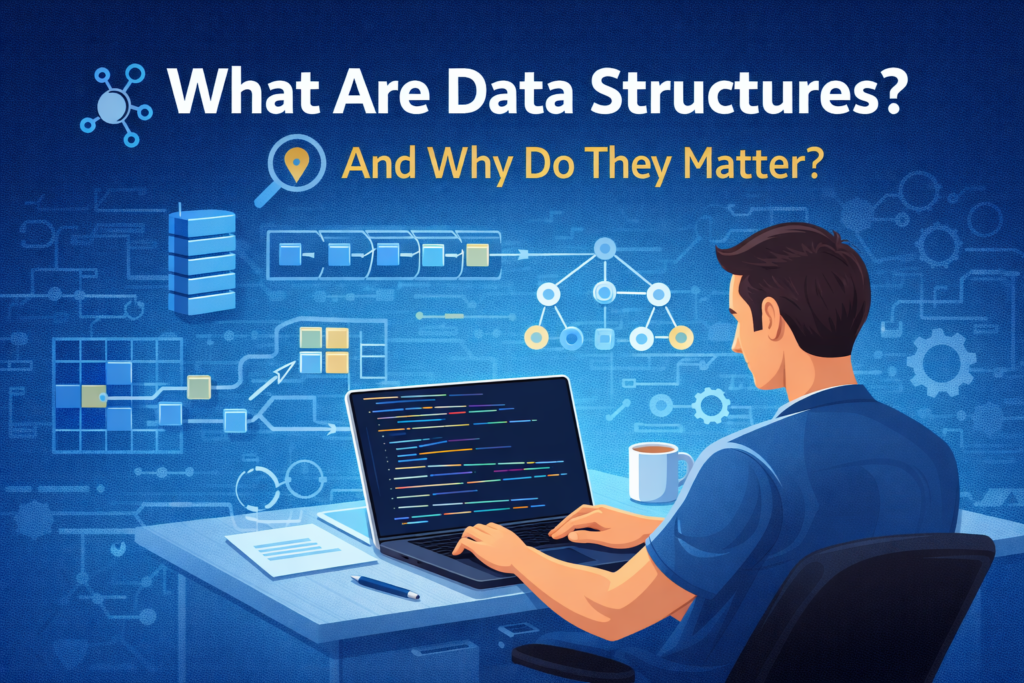
You don’t need to master everything at once. Most beginners start with these core data structures:
Arrays and Lists
Used to store collections of items in order. Simple, fast to access, but sometimes inefficient to modify.
Stacks
Follow a last in, first out approach. Common in undo features, function calls, and expression evaluation.
Queues
Follow a first in, first out rule. Used in scheduling, messaging systems, and task processing.
Hash Tables (Maps)
Store key–value pairs for fast lookups. Widely used in databases, caching, and configuration systems.
Trees
Organize data hierarchically. Used in file systems, databases, and search engines.
Graphs
Model relationships between entities. Used in social networks, recommendation systems, and routing algorithms.
How Data Structures Affect Performance
When engineers talk about performance, they often mean:
- How fast an operation runs
- How much memory it uses
Data structures directly influence both.
For example:
- Searching in a list may take longer as it grows
- Looking up a value in a hash table is usually much faster
- Trees and graphs enable complex queries that would otherwise be impractical
This is why data structures are closely tied to algorithm efficiency and scalability.
Do You Need Data Structures to Get a Job?
Yes — but not all at once.
Most entry-level roles expect you to:
- Understand basic data structures
- Know when to use them
- Explain your reasoning clearly
You’re not expected to memorize everything. Interviewers care more about how you think and solve problems than about perfect recall.
How Beginners Should Learn Data Structures
A practical approach works best:
- Start with simple structures like arrays and lists
- Learn one concept at a time
- Implement them in code
- Solve small problems using each structure
- Focus on understanding why a structure is used, not just how
Progress comes from consistency, not speed.
Final Thoughts
Data structures are not just an academic topic — they are a core skill that separates casual programmers from professional software engineers. They help you write better code, design scalable systems, and think more clearly about problems.
Whether you’re preparing for interviews or building real-world applications, a solid grasp of data structures will pay off throughout your career.
To continue learning — from foundational software engineering topics to advanced areas like AI — explore https://tooltechsavvy.com/.
Visit the blog to discover AI, cloud, DevOps, tools, and many other interesting topics designed to support your growth in tech.