Training AI models has always depended on one thing more than algorithms: data.
However, as privacy laws tighten, real-world data becomes harder to access, and edge cases remain rare, a new approach is taking centre stage—synthetic data generation.
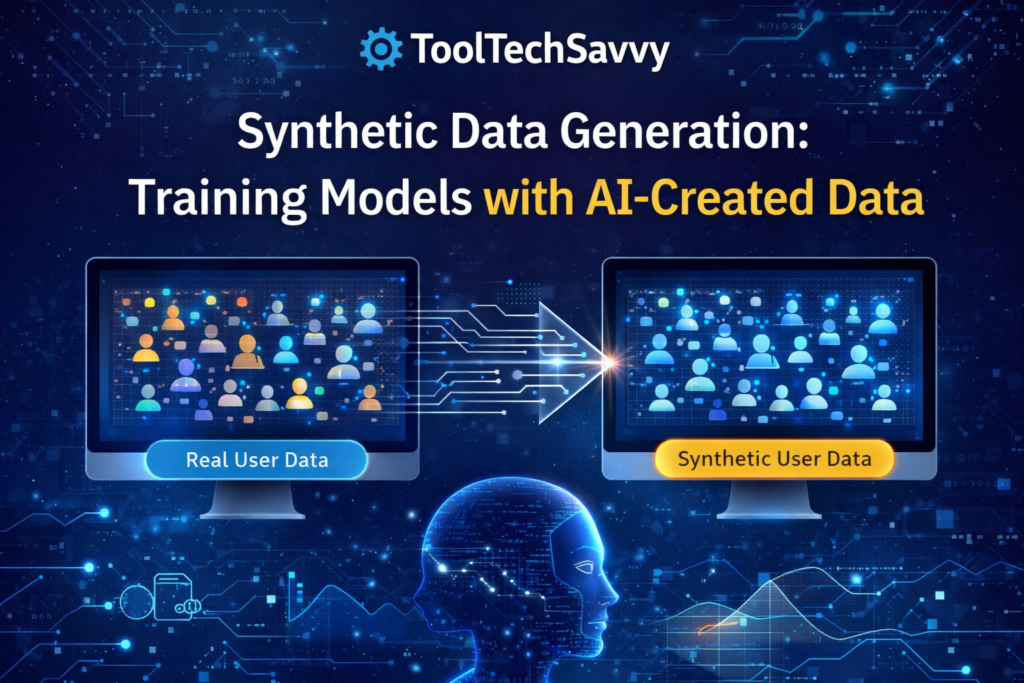
Instead of collecting more human data, organizations are now creating data with AI to train AI. This shift is quietly reshaping how modern models are built, tested, and deployed.
What Is Synthetic Data Generation?
Synthetic data is artificially generated data that mimics real-world patterns without directly copying real user information.
In simple terms:
- It looks real
- It behaves like real data
- But it contains no actual personal records
This makes it especially valuable in regulated industries like healthcare, finance, and enterprise AI.
If you’re still grounding your understanding of AI concepts, this plain-English guide is a great foundation:
https://tooltechsavvy.com/how-to-understand-ai-models-without-the-jargon/
Why Synthetic Data Matters More Than Ever
Several trends are converging:
1. Privacy and compliance pressures
Laws like GDPR and stricter internal policies limit how real user data can be used. Synthetic data offers a workaround without cutting corners.
To understand why privacy is becoming a core AI concern, see:
https://tooltechsavvy.com/data-privacy-101-what-happens-to-your-prompts-and-conversations/
2. Data scarcity for edge cases
Rare events—fraud, failures, medical anomalies—are exactly what models need to learn, yet real examples are limited.
Synthetic data allows teams to generate thousands of controlled variations of these scenarios.
3. Faster experimentation
Collecting and labeling real data takes time. Synthetic data can be generated, tested, and refined in hours.
This speed advantage mirrors why many teams experiment with models using free tools first:
https://tooltechsavvy.com/step-by-step-how-to-experiment-with-open-source-ai-models-free-tools/
How Synthetic Data Is Generated
Synthetic data is typically created using models trained on statistical patterns, not raw records.
Common approaches include:
- Generative models (GANs, VAEs)
- Large Language Models for structured text
- Simulation engines for physical systems
Modern LLMs are increasingly used to generate text, code, logs, and conversational data—especially for chatbot training and evaluation.
If you’re curious how models learn structure from examples, embeddings play a critical role:
https://tooltechsavvy.com/what-are-embeddings-ais-secret-to-understanding-meaning-simplified/
Synthetic Data vs Real Data (The Trade-Off)
Synthetic data is powerful—but not perfect.
Strengths
- Preserves privacy
- Scales infinitely
- Easy to rebalance biased datasets
- Enables stress testing
Limitations
- Can amplify hidden biases
- May miss real-world noise
- Depends heavily on the quality of the generator
This is why most production systems use hybrid pipelines—real data for grounding, synthetic data for scale.
That hybrid approach aligns with modern AI stacks discussed here:
https://tooltechsavvy.com/the-future-is-hybrid-everything-you-need-to-know-about-multi-modal-ai/
Synthetic Data in Model Training Pipelines
Synthetic data is rarely used alone. Instead, it fits into broader workflows such as:
- Pre-training augmentation
- Fine-tuning enrichment
- Evaluation and red-teaming
- Safety and robustness testing
When combined with retrieval-based systems, it becomes even more powerful. For example, synthetic Q&A pairs are often used to improve RAG pipelines.
If you’re building retrieval systems, this guide is essential:
https://tooltechsavvy.com/retrieval-augmented-generation-the-new-era-of-ai-search/
And if you want to go deeper:
https://tooltechsavvy.com/the-ultimate-guide-to-llm-data-integration-rag-vs-fine-tuning/
Bias, Safety, and Responsible Use
Synthetic data doesn’t automatically solve bias—it moves responsibility upstream.
If the generation model is biased, the synthetic data will be too.
That’s why responsible teams:
- Audit generation prompts
- Compare synthetic vs real distributions
- Use synthetic data for testing, not blind replacement
Understanding hallucinations helps explain why unchecked generation can drift from reality:
https://tooltechsavvy.com/understanding-ai-hallucinations-why-ai-makes-things-up/
Synthetic Data and the Rise of Agentic AI
As AI agents become more autonomous, synthetic data is increasingly used to:
- Simulate environments
- Train agents on failure cases
- Stress-test decision-making loops
This is especially relevant in agent frameworks and workflow automation, where real-world mistakes are costly.
For context on where agentic AI is heading:
https://tooltechsavvy.com/big-tech-and-agentic-ai-what-it-means-for-you/
And a beginner-friendly entry point:
https://tooltechsavvy.com/beginners-guide-to-ai-agents-smarter-faster-more-useful/
When Should You Use Synthetic Data?
Synthetic data makes the most sense when:
- Privacy is non-negotiable
- Real data is scarce or expensive
- You need controlled edge cases
- You’re testing safety, robustness, or scale
It is not a replacement for understanding your domain or validating against reality.
That mindset—tools as leverage, not shortcuts—is explored here:
https://tooltechsavvy.com/from-consumer-to-creator-shifting-your-ai-usage-mindset/
Final Thoughts
Synthetic data generation represents a quiet but foundational shift in AI development.
It allows teams to:
- Train responsibly
- Experiment faster
- Protect users
- Scale intelligently
However, like all AI tools, its power depends on how thoughtfully it’s used.
If you want to build AI systems that are scalable, safe, and future-ready, understanding synthetic data isn’t optional anymore—it’s essential.
For more practical AI guides, workflows, and deep dives, explore ToolTechSavvy:
https://tooltechsavvy.com/