Algorithms often sound intimidating to beginners. The word itself feels mathematical, complex, and academic. But in reality, algorithms are simply step-by-step instructions for solving problems — something humans do every day without realizing it.
Whether you’re building a website, searching a list, or processing user data, algorithms quietly power everything behind the scenes. This guide explains algorithms in simple terms, focusing on sorting, searching, and logical thinking.
What Is an Algorithm?
An algorithm is a clear set of steps used to complete a task or solve a problem.
Think of it like a recipe:
- Ingredients are your data
- Instructions are the steps
- The final dish is the result
In software, algorithms tell computers how to process information efficiently and correctly.
Why Algorithms Matter for Developers
Algorithms matter because they directly affect:
- Speed and performance
- Memory usage
- Scalability
- User experience
Two programs can solve the same problem, but the one using a better algorithm will run faster and handle more data.
Sorting Algorithms Explained Simply
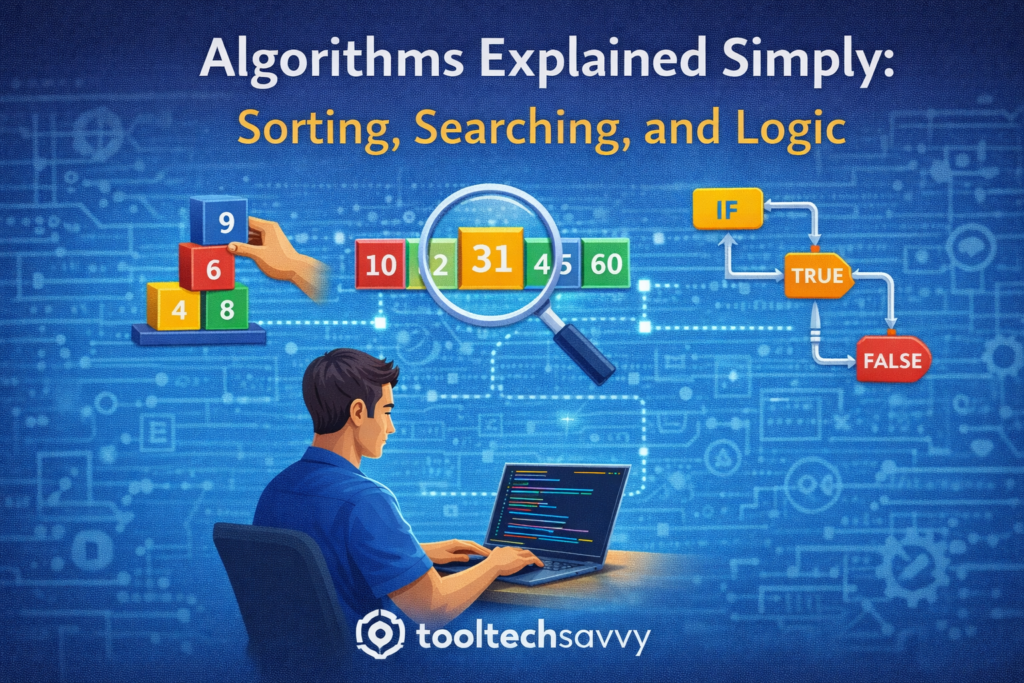
Sorting means arranging data in a specific order, such as numbers from smallest to largest or names alphabetically.
Why Sorting Is Important
Sorting helps:
- Display data clearly
- Speed up searching
- Improve organization
Common Sorting Approaches (Conceptually)
- Comparing items one by one
- Repeatedly placing items in the correct position
- Dividing data into smaller parts and sorting them
You don’t need to memorize every sorting algorithm at the start. What matters is understanding why sorting improves efficiency.
Searching Algorithms Explained Simply
Searching is about finding specific data inside a collection.
Linear Search (Simple Idea)
Check each item one by one until you find what you’re looking for.
- Easy to understand
- Slower for large datasets
Faster Searching (Conceptually)
If data is organized, searching becomes much faster by:
- Eliminating large portions at once
- Narrowing down the search space
This is why sorting and searching often go hand in hand.
Logic: The Heart of All Algorithms
At the core of every algorithm is logical thinking.
Logic involves:
- Making decisions
- Handling conditions
- Repeating steps
- Stopping at the right time
Examples of logic in algorithms include:
- “If this condition is true, do this”
- “Repeat until the task is complete”
- “Stop when the result is found”
Strong logic skills are more important than memorizing algorithms.
Algorithms Are Everywhere (Real-Life Examples)
You already use algorithms daily:
- Finding a contact in your phone
- Sorting emails by date
- Recommending videos or products
- Navigation apps choosing the fastest route
Software simply applies these ideas at massive scale.
Do Beginners Need to Master Algorithms?
No — not immediately.
Beginners should focus on:
- Understanding the idea behind algorithms
- Learning how problems are broken into steps
- Practicing logical thinking
- Applying simple sorting and searching techniques
Depth comes with experience and practice.
Algorithms, Data Structures, and Software Engineering
Algorithms don’t work alone. They rely on data structures to store and organize information.
Together, they help developers:
- Write efficient code
- Build scalable systems
- Solve complex problems cleanly
This foundation is critical for interviews, real-world projects, and advanced topics like AI.
Final Thoughts
Algorithms are not about memorization or math-heavy theory. They are about clear thinking, problem-solving, and efficiency. Once beginners understand sorting, searching, and logic, the rest of computer science becomes far less intimidating.
To continue learning — from algorithms and data structures to advanced topics like AI — visit https://tooltechsavvy.com/.
Explore the blog to discover AI, software engineering, cloud, DevOps, tools, and other interesting topics designed to help you grow confidently in tech