
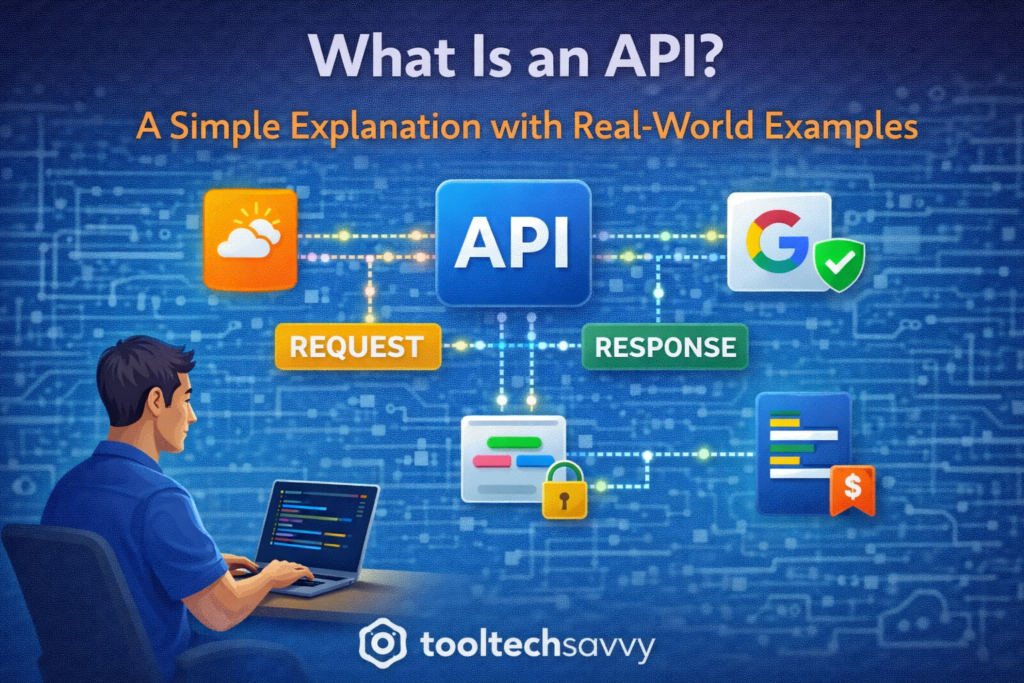
APIs are everywhere in modern technology, yet for many beginners, the term feels confusing and abstract. You hear it in conversations about apps, cloud platforms, AI tools, and integrations—but what does an API actually do?
In simple terms, APIs help different software systems talk to each other. This article explains APIs clearly, without jargon, using everyday examples you already understand.
What Does API Stand For?
API stands for Application Programming Interface.
That sounds technical, but the idea is simple:
An API defines how one piece of software can request information or actions from another.
It’s a set of rules that says:
- What you can ask for
- How you should ask
- What kind of response you’ll receive
A Real-World Analogy: APIs as a Restaurant Waiter
Imagine you’re at a restaurant.
- You (the user) don’t go into the kitchen
- You read the menu (available options)
- You place an order with the waiter
- The kitchen prepares the food
- The waiter brings it back
In this analogy:
- You are the application
- The waiter is the API
- The kitchen is the server or backend
The API acts as the middle layer that safely handles requests and responses.
Why APIs Exist
APIs exist to:
- Prevent direct access to internal systems
- Standardize communication between software
- Enable integration and automation
- Make systems reusable and scalable
Without APIs, modern apps simply wouldn’t work together.
Simple Examples of APIs You Use Every Day
Weather Apps
When you open a weather app, it doesn’t generate weather data itself.
It sends a request to a weather service API and displays the response.
Login with Google or Facebook
When you log into a website using Google:
- The site sends a request to Google’s API
- Google verifies your identity
- Google sends back a response
The website never sees your password.
Online Payments
When you make an online payment:
- The app sends payment details to a payment API
- The API processes the transaction securely
- A success or failure response is returned
APIs handle sensitive operations safely.
How APIs Work (Simplified Flow)
- An application sends a request
- The API receives the request
- The server processes it
- The API sends back a response
This usually happens in milliseconds.
Common Types of APIs Beginners Should Know
You don’t need to memorize everything, but awareness helps.
- Web APIs – Used by websites and apps
- REST APIs – Most common style for web services
- Internal APIs – Used within a company’s systems
- Public APIs – Available for developers to build on
Most beginner-friendly examples are REST-based web APIs.
Why APIs Matter for Developers
APIs allow developers to:
- Build features faster
- Reuse existing services
- Integrate third-party tools
- Focus on logic instead of reinventing everything
Modern development is largely about connecting systems, not building everything from scratch.
APIs and Modern Tech (Cloud, DevOps, AI)
APIs are foundational to:
- Cloud platforms
- Microservices architectures
- DevOps automation
- AI tools and integrations
If you understand APIs, many advanced tech concepts suddenly make sense.
Do Beginners Need to Learn APIs Early?
Yes—but conceptually first.
Beginners should focus on:
- Understanding what APIs do
- Knowing how requests and responses work
- Seeing how apps connect using APIs
Hands-on practice can come later, once fundamentals are clear.
Final Thoughts
APIs are not magic or mysterious. They are simply well-defined ways for software systems to communicate safely and efficiently. Once beginners understand APIs, modern technology becomes much easier to reason about—from web apps to cloud platforms to AI tools.
To continue learning—from API fundamentals to advanced topics like AI—visit https://tooltechsavvy.com/.
Explore the blog to discover AI, software engineering, cloud, DevOps, tools, and other interesting topics designed to help you grow confidently in tech.