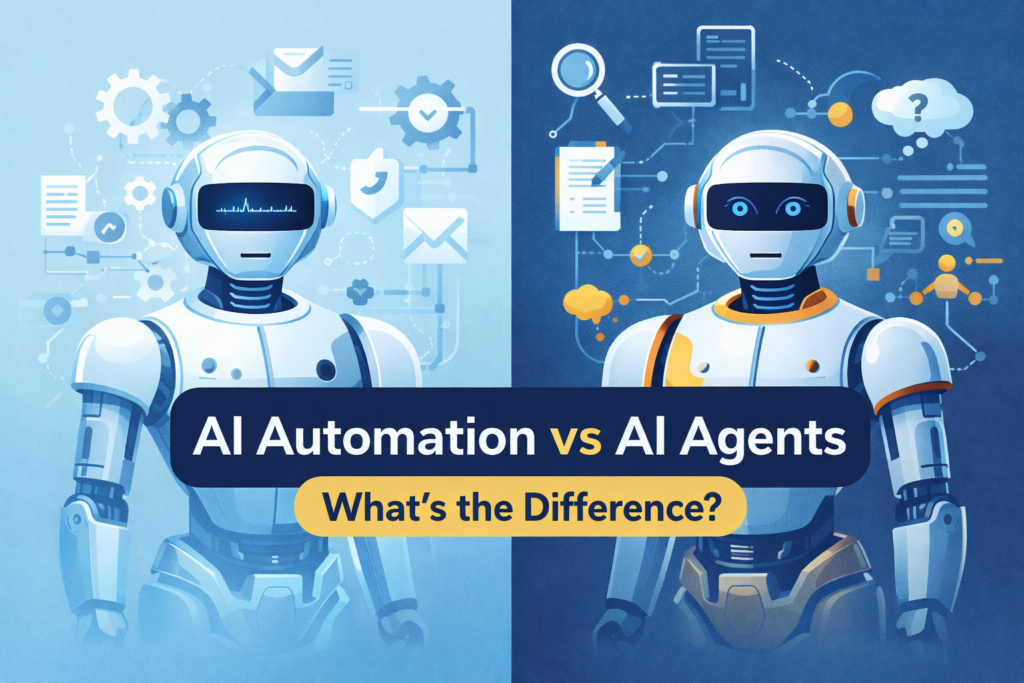
Artificial intelligence is no longer just about chatbots answering questions. Today, AI is actively doing work, making decisions, and even coordinating tasks on your behalf.
However, one question keeps coming up:
What’s the real difference between AI Automation and AI Agents—and why should you care?
Although these terms are often used interchangeably, they represent two very different stages of AI maturity. Understanding this distinction can help you choose the right tools, design better workflows, and future-proof your skills.
Let’s break it down in plain English.
What Is AI Automation? (The “If This, Then That” Era)
AI Automation focuses on rule-based workflows powered by AI models. In other words, it executes predefined steps once a trigger occurs.
Think of it as AI with guardrails.
For example:
- When a form is submitted → summarize it using AI → send an email
- When a calendar event is added → generate a task list
- When a blog is published → auto-share it on social platforms
Tools like Zapier, Make.com, and Notion workflows dominate this space. If you’re new, resources like ChatGPT for Beginners: 7 Easy Ways to Boost Productivity with AI show how automation improves daily work with minimal effort.
Key Characteristics of AI Automation
- Linear and predictable
- Trigger → action → output
- Low risk, easy to control
- Excellent for repetitive tasks
If you’ve ever automated emails, content calendars, or CRM updates, you’ve already used AI automation. Guides like How to Use ChatGPT and Zapier to Automate Your Content Calendar are perfect examples of this approach.
What Are AI Agents? (The “Figure It Out” Era)
AI Agents take things a step further.
Instead of following a strict script, agents are goal-driven systems that can:
- Decide what to do next
- Choose tools dynamically
- Learn from intermediate results
- Loop, retry, and self-correct
In short, you give agents an objective, not instructions.
For example:
“Research this topic, create an outline, write a draft, fact-check it, and suggest improvements.”
That single instruction can trigger dozens of internal steps—without you defining each one.
If this sounds futuristic, it’s already happening. Articles like Beginner’s Guide to AI Agents: Smarter, Faster, More Useful explain how agentic systems work behind the scenes.
Key Characteristics of AI Agents
- Goal-oriented, not step-based
- Can reason and adapt
- Use tools autonomously
- Handle ambiguity better
This shift is often called agentic AI, and it’s why many experts believe agents—not automations—are the next productivity leap.
AI Automation vs AI Agents: A Simple Comparison
| Feature | AI Automation | AI Agents |
|---|---|---|
| Logic | Rule-based | Reasoning-based |
| Flexibility | Low | High |
| Decision Making | Predefined | Autonomous |
| Error Handling | Manual | Self-correcting |
| Best For | Repetitive tasks | Complex workflows |
If automation is a checklist, agents are a project manager.
Why This Difference Actually Matters
At first glance, automation may seem “safer.” However, as workflows become more complex, automation starts to break.
That’s where agents shine.
For example:
- Automations struggle with edge cases
- Agents can pause, rethink, and adapt
- Automation saves time
- Agents replace cognitive effort
This is why Big Tech is investing heavily in agentic systems, as explored in Big Tech and Agentic AI: What It Means for You.
Real-World Examples You’ll Recognize
AI Automation in Action
- Auto-replying to emails
- Generating meeting summaries
- Syncing tools like Notion and Google Docs
- Scheduling content
Try beginner-friendly tools listed in Top 5 Free AI Tools You Can Start Using Today.
AI Agents in Action
- Research assistants that browse, summarize, and cite
- Coding agents that debug and refactor
- Personal AI teammates managing tasks across tools
If you’re curious, How to Deploy AI Agents for Everyday Tasks shows how this works without advanced coding.
Which One Should You Use?
Here’s a simple rule:
- Use AI Automation when tasks are predictable
- Use AI Agents when outcomes matter more than steps
In fact, the future isn’t either/or—it’s both.
Modern workflows often start with automation and escalate to agents when complexity increases, a concept explored in How to Build Complex Workflows with AI Copilots and Zapier.
The Bigger Picture: From Tools to Teammates
We’re witnessing a shift:
- From commands → collaboration
- From tools → teammates
- From workflows → ecosystems
This mindset shift is explained well in Unlock Your Potential with the Digital Copilot Mindset and How to Adopt the Agentic AI Mindset in 2025.
Final Thoughts
AI Automation helps you work faster.
AI Agents help you work smarter.
Understanding the difference allows you to:
- Choose the right tools
- Design scalable systems
- Stay relevant as AI evolves
As AI continues to mature, knowing when to automate and when to delegate to agents will become a core digital skill.
To explore more practical, beginner-friendly AI guides, workflows, and deep dives, visit ToolTechSavvy—your hub for understanding AI without the hype.