
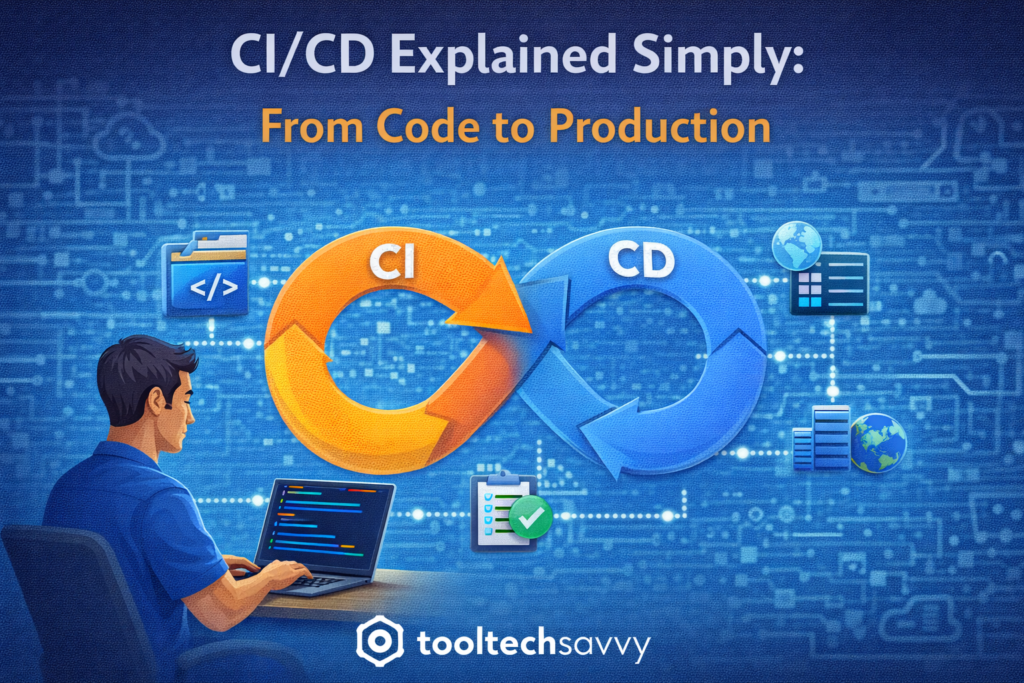
Modern software doesn’t ship once every few months anymore. It’s updated daily—or even multiple times a day. Behind this speed is a practice called CI/CD, which helps teams deliver code safely, quickly, and consistently.
For beginners, CI/CD can sound complex and tool-heavy. But at its core, CI/CD is simply about automating the journey from code to production. This guide breaks it down step by step, without jargon.
What Does CI/CD Mean?
CI/CD stands for:
- CI – Continuous Integration
- CD – Continuous Delivery or Continuous Deployment
Together, they describe a workflow where code changes are automatically tested, validated, and prepared for release.
Why CI/CD Exists
Before CI/CD, software releases were:
- Infrequent
- Manual
- Risky
- Stressful
Teams would merge large chunks of code at once, leading to bugs, downtime, and long recovery times.
CI/CD solves this by encouraging small, frequent, and automated updates.
Continuous Integration (CI) Explained Simply
Continuous Integration means developers frequently merge their code into a shared codebase, where it is automatically tested.
What Happens in CI?
- Code is pushed to a repository
- Automated tests run
- Errors are detected early
- Feedback is sent to developers quickly
CI helps catch bugs before they reach users.
Continuous Delivery vs Continuous Deployment
This is where beginners often get confused.
Continuous Delivery
- Code is always ready to be released
- Deployment is usually triggered manually
Continuous Deployment
- Code is automatically released to production
- No manual approval step
Both approaches reduce risk by making releases smaller and predictable.
The CI/CD Pipeline: Step-by-Step
A typical CI/CD pipeline looks like this:
- Developer writes code
- Code is committed to a repository
- Automated tests run
- Code is built and packaged
- Security and quality checks run
- Application is deployed
Each step happens automatically, ensuring consistency.
Why CI/CD Matters for Companies
Companies invest in CI/CD because it helps them:
- Release features faster
- Reduce production failures
- Improve software quality
- Recover quickly from issues
- Scale development teams efficiently
In competitive markets, faster and safer delivery is a major advantage.
Why CI/CD Matters for Developers
For developers, CI/CD:
- Reduces manual work
- Provides fast feedback
- Builds confidence in code changes
- Encourages clean, testable code
Even junior developers benefit from understanding how their code reaches production.
CI/CD Is Not Just About Tools
A common misconception is that CI/CD is only about using certain tools.
In reality, CI/CD is about:
- Automation
- Consistency
- Collaboration
- Continuous improvement
Tools support the process, but mindset and discipline make it effective.
How CI/CD Fits into DevOps and Cloud
CI/CD is a core part of:
- DevOps workflows
- Cloud-native development
- Microservices architectures
It connects development, testing, operations, and monitoring into a single automated flow.
Do Beginners Need to Learn CI/CD Early?
Yes — at a conceptual level.
Beginners don’t need to build complex pipelines immediately. Instead, they should focus on:
- Understanding the CI/CD flow
- Knowing why automation matters
- Learning how code moves to production
This foundation makes advanced DevOps topics much easier later.
Final Thoughts
CI/CD turns software delivery from a risky event into a reliable process. By automating testing and deployment, teams can move faster without sacrificing quality.
For beginners, understanding CI/CD is not about memorizing tools—it’s about understanding how modern software is built and shipped.
To continue learning—from CI/CD fundamentals to advanced topics like AI—visit https://tooltechsavvy.com/.
Explore the blog to dive into AI, software engineering, cloud, DevOps, tools, and other interesting topics designed to help you grow confidently in tech