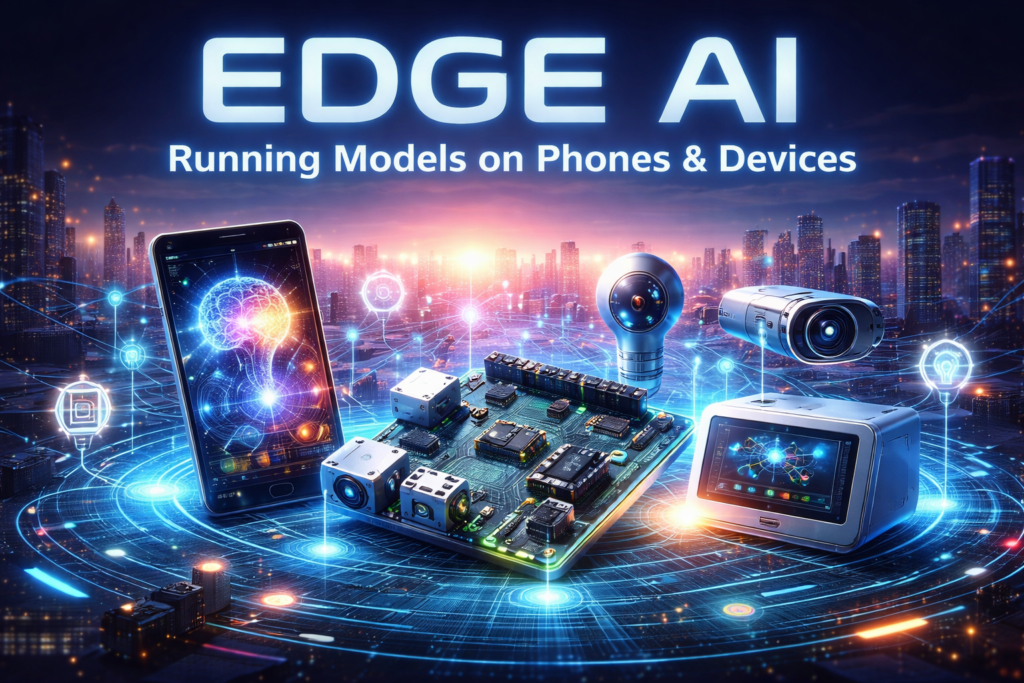
For years, artificial intelligence lived almost entirely in the cloud. Models were large, slow to access, and dependent on constant internet connectivity. However, that’s quickly changing. Edge AI—running AI models directly on devices like smartphones, Raspberry Pi boards, and IoT hardware—is becoming one of the most important shifts in modern computing.
In this guide, we’ll break down what Edge AI is, why it matters, and how it’s already shaping real-world applications, without jargon or hype.
If you’re still getting started with AI fundamentals, our beginner-friendly guide ChatGPT for Beginners: 7 Easy Ways to Boost Productivity with AI is a great place to begin.
What Is Edge AI?
Simply put, Edge AI means running AI models locally on devices instead of relying on cloud servers.
Rather than sending data to a remote data center:
- The model lives on the device
- Inference happens instantly
- Data stays local
This shift aligns closely with broader trends in open-source AI, which we explored in Meta’s New Open-Source LLM: What It Means for AI Innovation.
Why Edge AI Is Gaining Momentum
Several forces are pushing AI toward the edge.
1. Faster Response Times
Because there’s no round trip to the cloud, Edge AI delivers real-time results, which is critical for applications like voice assistants, smart cameras, and autonomous systems.
2. Better Privacy
Sensitive data—such as images, audio, or health metrics—never leaves the device. This is increasingly important as users grow more aware of data privacy concerns, a topic we often cover on ToolTechSavvy.
3. Lower Costs
Cloud inference isn’t cheap. Running models locally can dramatically reduce ongoing costs, especially at scale—an idea that pairs well with efficient workflow strategies discussed in Optimizing AI Workflows: Batching, Caching, and Rate Limiting.
Edge AI on Smartphones
Modern smartphones are already AI powerhouses.
Apple, Google, and other manufacturers now ship devices with:
- Neural Processing Units (NPUs)
- On-device language models
- Local image and speech recognition
This is why features like real-time translation, photo enhancement, and voice typing feel instant.
If you’ve explored tools like Gemini, our guide Google Gemini Made Easy: A Beginner’s Guide to AI-Powered Answers shows how much intelligence already runs close to the user.
Edge AI on Raspberry Pi
Raspberry Pi has become the playground for Edge AI experimentation.
With lightweight models and frameworks, developers can:
- Run object detection
- Build smart cameras
- Create voice-controlled assistants
- Prototype IoT solutions
This hands-on experimentation fits perfectly with the learning philosophy explained in Step-by-Step: How to Experiment with Open-Source AI Models (Free Tools).
Edge AI in IoT Devices
IoT devices generate enormous amounts of data—but sending everything to the cloud is inefficient.
Edge AI allows IoT systems to:
- Detect anomalies locally
- Respond instantly to events
- Operate even without connectivity
Smart thermostats, industrial sensors, and wearable devices all rely on this model. As AI agents become more autonomous, Edge AI will play a foundational role—especially in scenarios discussed in Beginners Guide to AI Agents: Smarter, Faster, More Useful.
What Models Work Best for Edge AI?
Not all models are suitable for edge environments.
Edge-friendly models tend to be:
- Smaller
- Quantized
- Optimized for low power
This is where Small Language Models (SLMs) and efficient architectures shine, a concept we explore in Small Language Models (SLMs): When Bigger Isn’t Better.
Edge AI vs Cloud AI: A Quick Comparison
| Feature | Edge AI | Cloud AI |
|---|---|---|
| Latency | Very low | Higher |
| Privacy | High | Lower |
| Cost | Lower long-term | Ongoing usage costs |
| Model Size | Smaller | Large |
| Offline Support | Yes | No |
In reality, the future isn’t one or the other—it’s hybrid, as we discussed in The Future Is Hybrid: Everything You Need to Know About Multi-Modal AI.
Challenges of Edge AI
Despite its benefits, Edge AI isn’t without trade-offs.
- Limited compute power
- Model optimization complexity
- Hardware variability
Understanding these trade-offs helps avoid unrealistic expectations—similar to learning how to understand AI models without the jargon, covered in How to Understand AI Models Without the Jargon.
What Edge AI Means for Everyday Users
For most users, Edge AI simply means:
- Better privacy
- Faster apps
- Smarter devices
You don’t need to understand neural networks to benefit from it—just like you don’t need to know AI architecture to use tools effectively, as explained in Do You Need to Understand AI Architecture to Use It?.
Final Thoughts
Edge AI represents a major shift in how intelligence is deployed—from distant servers to devices we use every day. As models become smaller and hardware more capable, Edge AI will quietly power the next generation of smart experiences.
If you want to stay ahead of these trends—without drowning in technical complexity—explore more practical, beginner-friendly AI guides at https://tooltechsavvy.com/ and continue building your AI knowledge one step at a time.