
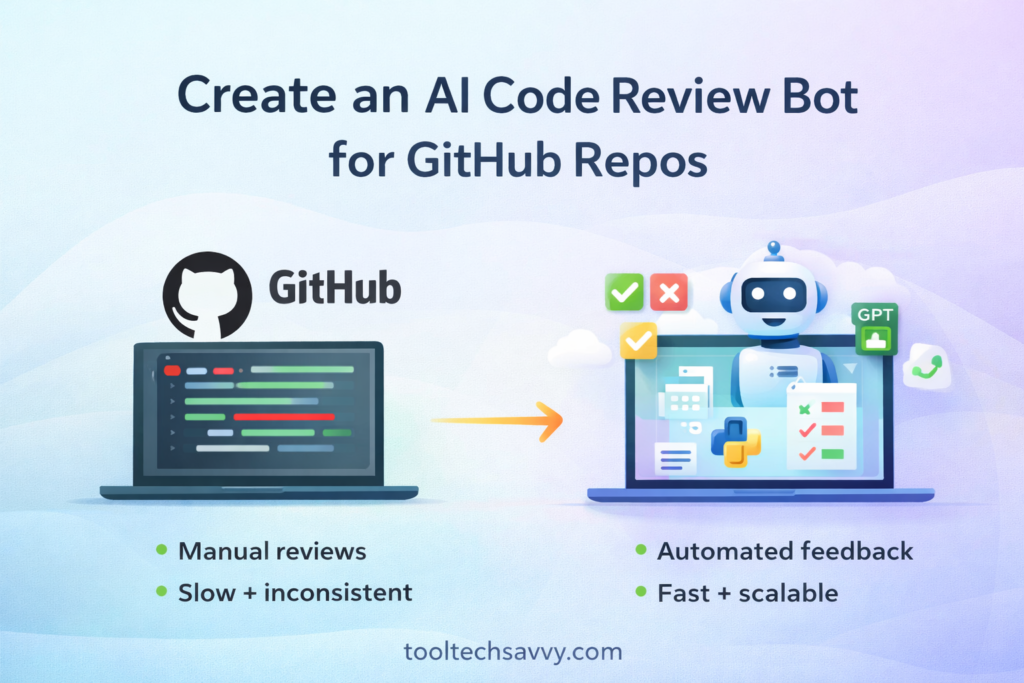
Code reviews are essential—but they’re also time-consuming. As repositories grow and teams move faster, manual reviews often become bottlenecks. That’s exactly why AI-powered code review bots are becoming a must-have for modern development teams.
In this guide, we’ll walk through how to create an AI code review bot for your GitHub repositories, what tools you need, and how to integrate AI into your existing workflow—without overengineering the solution.
Why AI Code Review Matters in 2025
Traditional code reviews depend heavily on human availability and consistency. Meanwhile, AI brings speed, pattern recognition, and scalability.
An AI code review bot can:
- Flag bugs and anti-patterns early
- Enforce coding standards automatically
- Improve pull request turnaround time
- Reduce reviewer fatigue
As AI copilots continue to evolve—highlighted in AI Copilot Updates 2025—automated code intelligence is quickly becoming the norm, not the exception.
What Is an AI Code Review Bot?
An AI code review bot is a system that:
- Monitors pull requests in your GitHub repositories
- Analyzes code changes using an AI model
- Posts structured feedback directly on the PR
Unlike static linters, AI bots understand context, making them especially useful for reviewing logic, readability, and maintainability.
Core Components of an AI Code Review Bot
Before jumping into implementation, let’s break down the building blocks.
1. GitHub Webhooks
Webhooks notify your system whenever a pull request is opened or updated.
2. AI Model (LLM)
Large Language Models analyze diffs and provide feedback. Choosing the right model matters—a concept explained clearly in How to Choose the Right AI Model for Your Workflow.
3. Prompt Engineering
Your prompt determines how helpful the review will be. Poor prompts produce vague feedback, while well-structured prompts produce actionable insights. If you’re new to this, Prompt Chaining Made Easy is a great place to start.
4. Automation Layer
This connects GitHub events to AI responses—often using tools like Zapier or custom scripts.
Step-by-Step: Building the AI Code Review Bot
Step 1: Detect Pull Requests Automatically
Set up GitHub webhooks to trigger when a pull request is created or updated. This ensures your bot reacts instantly, without manual input.
If you prefer no-code automation, the logic mirrors workflows described in How to Use Zapier Filters and Paths for Complex Automations.
Step 2: Extract Code Changes
Once triggered, fetch the pull request diff. This provides the raw code context the AI needs to analyze.
At this stage, structure matters. Clean inputs lead to better outputs—a principle reinforced in Version Control for Prompts.
Step 3: Design a Code Review Prompt
Your prompt should instruct the AI to:
- Identify bugs and edge cases
- Suggest performance improvements
- Flag security risks
- Maintain constructive tone
If you’re unsure how to design role-based prompts, How to Use GPTs Like a Pro explains this perfectly.
Step 4: Generate AI Feedback
Pass the code diff and prompt to your chosen AI model. The output should be structured, concise, and reviewer-friendly.
This approach aligns well with ideas from Vibe Coding Explained—where AI supports developers rather than replacing them.
Step 5: Post Comments Back to GitHub
Finally, use GitHub’s API to post AI feedback directly on the pull request. This keeps everything centralized where developers already work.
At this point, your AI code review bot is fully functional.
Best Practices for AI Code Review Bots
While automation is powerful, balance is key.
Don’t Replace Human Review Entirely
AI should assist, not decide. This mindset is critical in responsible AI usage, as discussed in The Responsibility Mindset.
Start Narrow
Begin with style, readability, and obvious bugs before expanding to architecture-level feedback.
Continuously Improve Prompts
Treat prompts like code—iterate, test, and refine. Stop Guessing: A/B Test Your Prompts offers a practical framework.
Who Should Use an AI Code Review Bot?
AI code review bots are especially useful for:
- Solo developers managing multiple repos
- Startups moving fast with small teams
- Open-source maintainers handling many PRs
- Teams adopting AI-first workflows
If you’re still building confidence with AI tools, ChatGPT for Beginners provides a solid foundation.
Final Thoughts
Creating an AI code review bot for your GitHub repositories isn’t about replacing developers—it’s about removing friction. By automating repetitive checks and surfacing insights faster, AI frees humans to focus on design, logic, and innovation.
As agentic workflows and AI teammates become mainstream, learning to build tools like this puts you ahead of the curve—both technically and strategically.
For more beginner-friendly AI workflows, automation guides, and real-world use cases, explore more articles on https://tooltechsavvy.com/