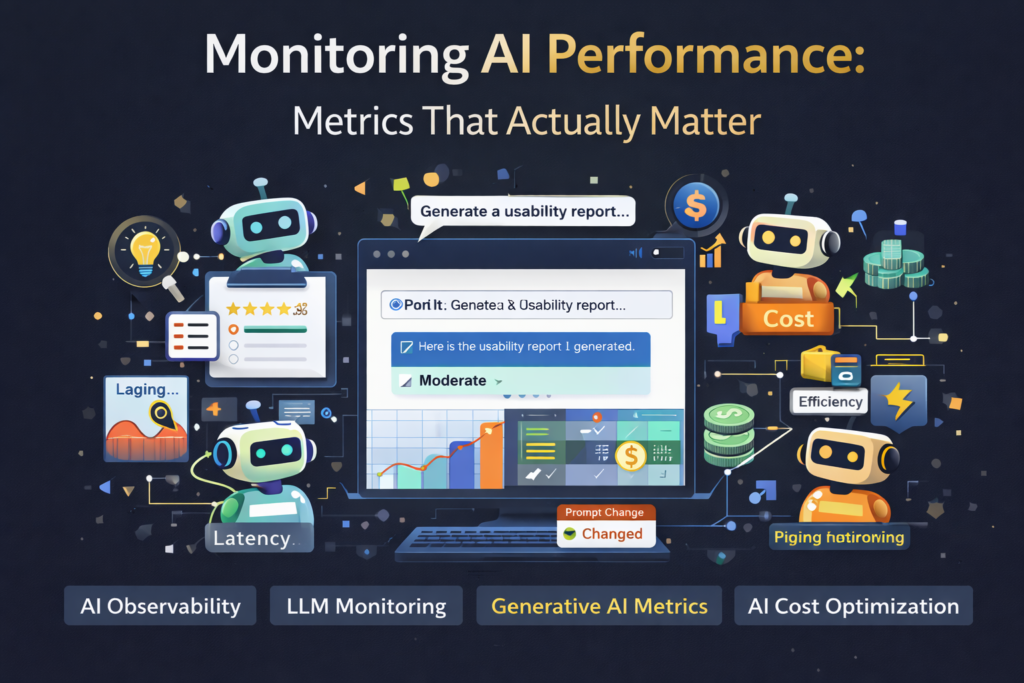
Building an AI system is only half the job.
The real challenge begins after deployment, when models face unpredictable inputs, changing user behavior, and real-world constraints. Yet many teams still track the wrong signals—accuracy scores in isolation, vanity metrics, or dashboards that don’t reflect reality.
In this guide, we’ll break down which AI performance metrics actually matter, why some popular metrics mislead teams, and how to monitor AI systems in a way that drives reliability, trust, and long-term value.
Why Monitoring AI Performance Is Different
Unlike traditional software, AI systems:
- Produce probabilistic outputs
- Can degrade silently over time
- Depend heavily on prompts, data, and context
That’s why monitoring AI performance isn’t just about uptime—it’s about output quality, behavior drift, and user impact.
If you’re still early in your AI journey, this beginner-friendly overview on how ChatGPT boosts productivity shows why output quality matters more than raw speed.
The Problem With “Accuracy” Alone
Accuracy works well for classic ML classification tasks. However, for generative AI, it quickly falls apart.
Why?
- There is often no single correct answer
- Outputs are contextual and subjective
- Hallucinations can appear confident but wrong
This is why understanding AI hallucinations and why they happen is essential before defining any performance metric.
Core AI Performance Metrics That Actually Matter
1. Output Quality (Human-Aligned Accuracy)
Instead of binary accuracy, focus on:
- Helpfulness
- Relevance
- Factual grounding
- Task completion rate
Human review or lightweight scoring frameworks often outperform automated checks here.
If you’re improving outputs through better prompts, advanced prompt patterns directly impact this metric.
2. Hallucination Rate
This is one of the most critical—and overlooked—metrics.
Track:
- Percentage of responses requiring correction
- Number of unsupported claims
- User-reported inaccuracies
Systems using retrieval-augmented generation consistently outperform prompt-only systems. If accuracy matters, see how RAG improves AI reliability.
3. Latency (Response Time)
Speed matters—but only after correctness.
Monitor:
- Median response time
- Tail latency (P95 / P99)
- Timeout rates under load
As systems scale, batching and caching become essential. This guide on optimizing AI workflows explains how teams keep latency predictable.
4. Token Usage & Cost Efficiency
AI performance isn’t just technical—it’s financial.
Key metrics include:
- Tokens per request
- Cost per successful task
- Cost per user session
Understanding token limits and prompt sizing helps avoid runaway costs without sacrificing quality.
5. Prompt Stability
Small prompt changes can cause large output shifts.
Track:
- Output variance across prompt versions
- Regression failures
- Prompt drift over time
This is why version control for prompts is becoming standard practice in mature AI teams.
6. User Satisfaction & Trust Signals
No metric matters more than users abandoning your system.
Watch for:
- Retry frequency
- Manual overrides
- Follow-up clarification prompts
- Drop-off after AI responses
These signals often reveal problems long before logs do.
Metrics That Matter More in Agentic Systems
If you’re using multi-step or autonomous agents, monitoring becomes more complex.
In agentic workflows, track:
- Task completion rate
- Tool-call failure rate
- Looping or stuck behaviors
- Handoff failures between agents
If this sounds familiar, beginner guides to AI agents explain why observability is critical in agent-based systems.
Why Context Window Usage Matters
Many failures aren’t model issues—they’re context issues.
Track:
- Prompt length growth
- Retrieval chunk size
- Context window overflow events
This deep dive on why ChatGPT forgets things explains why uncontrolled context leads to degraded performance.
Align Metrics With Real Business Outcomes
Ultimately, AI performance metrics should map to human and business goals, not model benchmarks.
Instead of asking:
“Is the model accurate?”
Ask:
- Did it save time?
- Did it reduce errors?
- Did it improve decision-making?
- Did it lower operational cost?
This mindset shift mirrors the 80/20 rule in AI learning—focus on what moves results, not what looks impressive.
Common Monitoring Mistakes to Avoid
Even advanced teams stumble when they:
- Track too many metrics with no action plan
- Ignore qualitative feedback
- Trust automated evaluations blindly
- Fail to log prompts and responses
If AI runs without oversight, you’re still accountable—something covered clearly in the responsibility mindset for AI outputs.
Final Thoughts: Measure What You Can Improve
AI monitoring isn’t about perfection—it’s about visibility.
When you track:
- Output quality
- Hallucinations
- Latency
- Cost
- Stability
You gain leverage to improve systems continuously instead of reacting to failures.
For more practical, no-fluff guides on AI systems, workflows, and real-world implementation, explore https://tooltechsavvy.com/ and build AI that performs where it actually counts.