
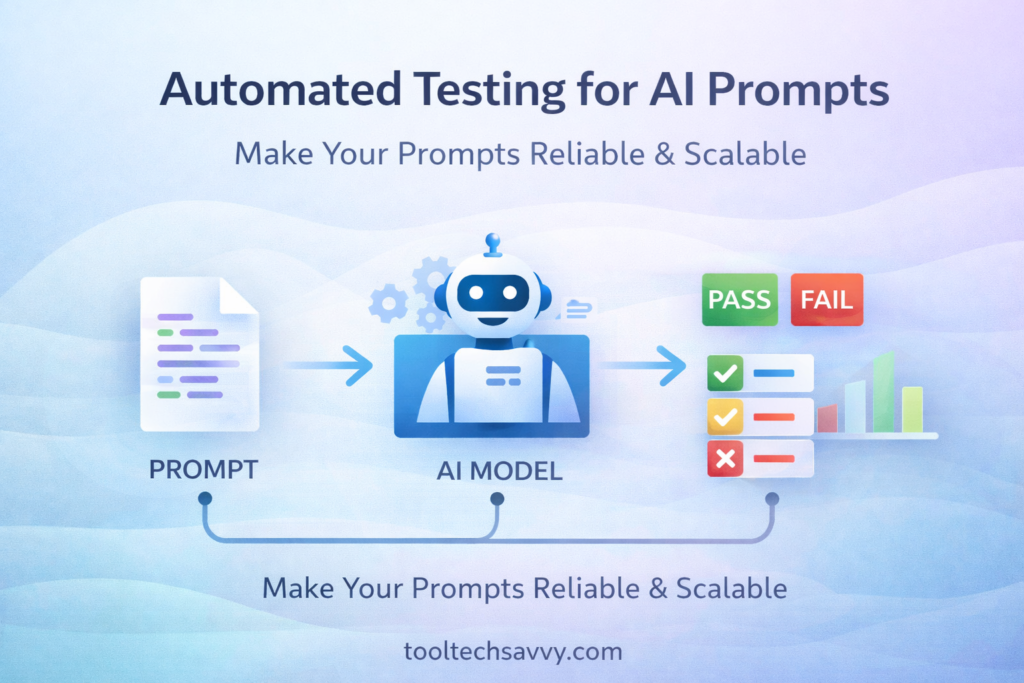
AI prompts are no longer just experiments—they’re becoming core infrastructure for products, workflows, and automation systems. Yet, while developers rigorously test code, prompts are often shipped without any structured testing at all.
That gap creates risk.
In this guide, we’ll break down how to set up automated testing for your AI prompts, why it matters, and how to build a reliable prompt-testing workflow that scales as your AI usage grows.
Why Prompt Testing Matters More Than You Think
AI prompts behave differently from traditional code. Small wording changes can drastically alter outputs, tone, or accuracy. Without testing, teams often discover problems only after users notice them.
Automated prompt testing helps you:
- Catch regressions early
- Maintain consistent outputs
- Compare prompt versions objectively
- Reduce hallucinations and edge-case failures
As AI tools become everyday productivity companions—explored in ChatGPT for Beginners: 7 Easy Ways to Boost Productivity with AI—prompt reliability becomes non-negotiable.
What Is Automated Prompt Testing?
Automated prompt testing is the process of:
- Running predefined inputs through your prompts
- Evaluating outputs against expected criteria
- Flagging failures or performance drops automatically
Unlike traditional unit tests, prompt tests focus on behavior, not exact outputs.
This mindset aligns with modern AI workflows discussed in Version Control for Prompts.
Key Elements of a Prompt Testing System
Before setting anything up, it’s important to understand the building blocks.
1. Test Inputs
These are representative user queries—normal cases, edge cases, and failure scenarios.
2. Evaluation Criteria
Instead of exact matches, use checks like:
- Relevance
- Tone
- Completeness
- Safety
This approach pairs well with strategies from Stop Guessing: A/B Test Your Prompts.
3. Prompt Variants
Testing only one prompt tells you nothing. Testing multiple versions helps you compare performance objectively.
If you’re new to structured prompt design, Prompt Chaining Made Easy offers a solid foundation.
Step-by-Step: Setting Up Automated Prompt Testing
Step 1: Define the Prompt’s Job
Start by writing down what the prompt should consistently do:
- Who is it for?
- What format should it return?
- What should it never do?
Role clarity is critical, as explained in How to Use GPTs Like a Pro.
Step 2: Create a Prompt Test Dataset
Build a small dataset of:
- Ideal inputs
- Ambiguous inputs
- Adversarial or confusing inputs
This mirrors real-world usage patterns and helps surface weaknesses early.
Step 3: Automate Prompt Execution
Use scripts or automation tools to run the same inputs across prompt versions. No-code users can replicate this logic using workflows similar to How to Use Zapier Filters and Paths for Complex Automations.
Step 4: Score the Outputs
Rather than binary pass/fail, score outputs on:
- Accuracy
- Clarity
- Helpfulness
Over time, this creates a performance baseline you can track.
This evaluation mindset complements insights from How to Monitor AI Performance.
Step 5: Track Prompt Changes Over Time
Treat prompts like living artifacts. Each iteration should be tested, logged, and compared against previous versions.
This disciplined approach is essential in production workflows and is reinforced in The Responsibility Mindset.
Common Mistakes to Avoid
Even with testing in place, teams often stumble in predictable ways.
Testing Only “Happy Paths”
Prompts break in edge cases—test those first.
Expecting Identical Outputs
AI outputs vary. Test for intent, not wording.
Ignoring Model Updates
Model updates can change behavior overnight, making continuous testing critical—especially as discussed in What OpenAI’s Latest GPT Update Means.
Who Should Be Testing AI Prompts?
Automated prompt testing isn’t just for engineers. It benefits:
- Product teams building AI features
- Marketers using AI for content workflows
- Founders deploying AI assistants
- Creators automating daily tasks
If you’re experimenting with AI-driven workflows, How to Build Complex Workflows with AI Copilots shows how prompts fit into larger systems.
Final Thoughts
Prompts are becoming the new interface layer between humans and machines. Treating them casually is no longer sustainable.
By setting up automated testing for your AI prompts, you move from guesswork to measurable reliability—and that’s what separates experiments from production-ready AI.
For more practical, beginner-friendly guides on AI workflows, prompt engineering, and automation, explore the full library at https://tooltechsavvy.com/