Artificial intelligence has completely reshaped the creative landscape. Today, anyone—from solo creators to startup teams—can generate stunning visuals using AI design tools in minutes. However, with so many options available, choosing the right tool can feel overwhelming.
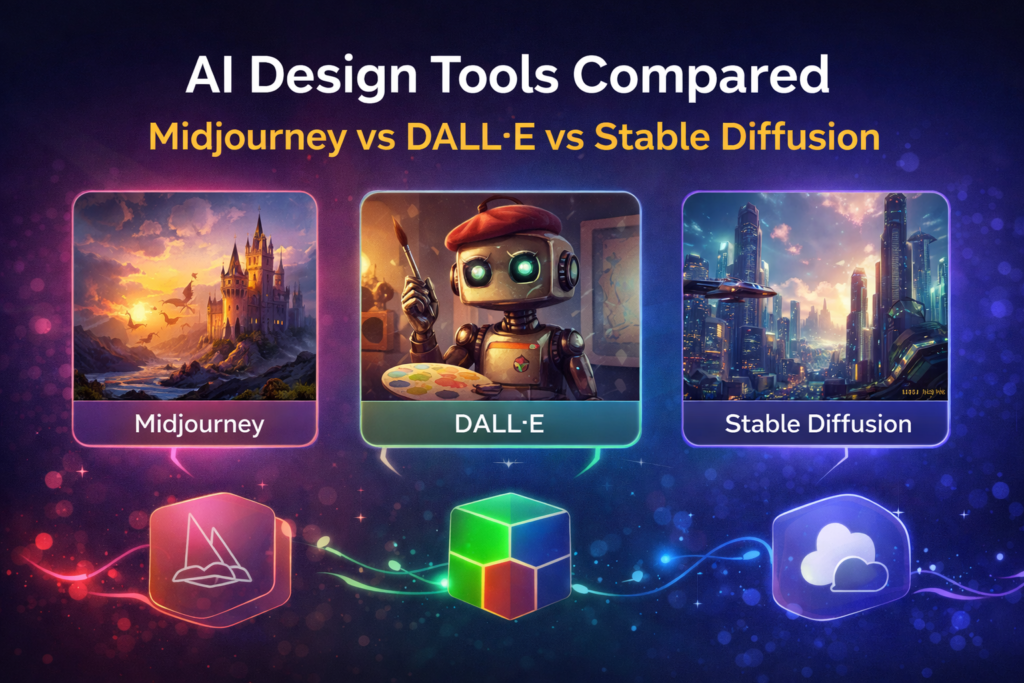
That’s why this guide breaks down Midjourney, DALL·E, and Stable Diffusion, compares their strengths, and explores practical alternatives—all in simple terms.
If you’re new to AI tools, you may want to start with our beginner-friendly guide on ChatGPT for Beginners: 7 Easy Ways to Boost Productivity with AI before diving deeper into creative workflows.
Why AI Design Tools Matter in 2025
Before comparing tools, it’s important to understand why AI design matters.
AI-generated images are now widely used for:
- Blog feature images
- Marketing creatives and ads
- Social media content
- Product mockups
- Concept art and ideation
More importantly, AI design tools remove technical barriers—meaning you don’t need design skills to create professional visuals. This aligns perfectly with the broader trend we covered in Top 5 Free AI Tools You Can Start Using Today (No Tech Skills Needed).
Midjourney: Best for Artistic and Stylized Visuals
Midjourney has earned a reputation for producing highly artistic, cinematic, and imaginative images.
Key Strengths
- Exceptional aesthetic quality
- Strong understanding of creative prompts
- Ideal for concept art, illustrations, and branding
Limitations
- Works primarily through Discord
- Less control over fine details compared to open-source tools
- Subscription required
Midjourney shines when creativity matters more than precision. For creators focused on visuals rather than workflows, it pairs well with productivity strategies discussed in 10 Expert-Recommended Chrome Extensions to Maximize Productivity.
DALL·E: Best for Simplicity and Accuracy
DALL·E, developed by OpenAI, focuses on clarity, usability, and safe image generation.
Key Strengths
- Easy to use, beginner-friendly interface
- Strong alignment with natural language prompts
- Built-in safety and moderation
Limitations
- Less artistic flexibility than Midjourney
- Limited customization options
- Not open-source
If you’re already using AI tools like ChatGPT, DALL·E fits naturally into your workflow. You can even combine it with automation ideas from How to Use ChatGPT and Zapier to Automate Your Content Calendar.
Stable Diffusion: Best for Customization and Control
Stable Diffusion stands out because it is open-source and highly flexible.
Key Strengths
- Can be run locally or via cloud platforms
- Extensive customization and fine-tuning
- Strong community and plugin ecosystem
Limitations
- Higher learning curve
- Requires setup and experimentation
- Output quality depends heavily on prompt skills
For users who enjoy tweaking workflows, Stable Diffusion aligns well with the mindset explained in How to Choose the Right AI Model for Your Workflow.
Midjourney vs DALL·E vs Stable Diffusion (Quick Comparison)
| Feature | Midjourney | DALL·E | Stable Diffusion |
|---|---|---|---|
| Ease of Use | Medium | Very Easy | Advanced |
| Artistic Style | Excellent | Good | Variable |
| Customization | Limited | Low | Very High |
| Open Source | No | No | Yes |
| Best For | Creators & artists | Beginners | Power users |
Best AI Design Tool Alternatives Worth Exploring
While the “big three” dominate conversations, several alternatives are gaining traction:
Canva AI
Perfect for social media graphics and presentations—especially for non-designers.
Adobe Firefly
Strong integration with professional design tools and brand-safe outputs.
Leonardo AI
Popular among game designers and concept artists for detailed asset creation.
Exploring multiple tools follows the minimalist selection approach discussed in How to Select AI Tools Without Getting Overwhelmed.
How to Get Better Results from AI Design Tools
No matter which tool you choose, results depend on how you prompt.
To improve output quality:
- Be specific with styles and details
- Use reference images where supported
- Iterate prompts instead of starting over
For a deeper dive, see Prompt Chaining Made Easy: Learn with Real-World Examples and 5 Advanced Prompt Patterns for Better AI Outputs.
Which AI Design Tool Should You Choose?
Ultimately, the “best” AI design tool depends on your goals:
- Choose Midjourney if visual creativity is your top priority
- Choose DALL·E if you want fast, reliable, beginner-friendly results
- Choose Stable Diffusion if you value control, customization, and open-source flexibility
Many creators actually use multiple tools—just as discussed in How to Balance Creativity and Automation in the AI Era.
Final Thoughts
AI design tools are no longer optional—they’re becoming essential creative companions. Whether you’re a blogger, marketer, or solo founder, learning how to use tools like Midjourney, DALL·E, and Stable Diffusion gives you a serious edge.
If you want to continue building smarter AI workflows, explore more beginner-friendly guides, tool comparisons, and automation strategies on https://tooltechsavvy.com/ hub for practical AI knowledge without the hype.