AI APIs are incredible for summarizing documents, generating content, and automating workflows—but they’re also a fast way to leak sensitive information if you don’t sanitize inputs properly. In practice, “data sanitization” means removing (or transforming) anything that could identify a person, expose credentials, reveal proprietary content, or unintentionally grant access—before the request ever reaches the model.
Below is a practical, engineering-friendly guide you can follow every time you send data to OpenAI, Anthropic, Gemini, or any other LLM endpoint.
Why data sanitization matters (even if you “trust” the provider)
Even reputable AI providers can’t protect you from accidental disclosure if your app sends secrets in plain text. More importantly, you often don’t control where text comes from—users paste screenshots, logs, emails, and internal notes without realizing what’s inside.
If you’ve ever built workflows that pass data between tools, this becomes critical. Automation amplifies mistakes. (If you’re doing multi-step automations, see how data moves across steps in workflows like Zapier paths and complex automations.)
Internal link: https://tooltechsavvy.com/how-to-use-zapier-filters-and-paths-for-complex-automations/
The “Remove First” list (the high-risk stuff)
If you remember nothing else, remove these categories first.
1) Credentials and secrets
This is the biggest and most common failure.
Remove:
- API keys (OpenAI, Google, AWS, Stripe, etc.)
- OAuth tokens, refresh tokens
- Passwords, PINs, one-time codes
- Private keys, certificates
- Session cookies, auth headers
If you’re unsure what counts as a secret, treat anything that can authenticate, authorize, or unlock a system as sensitive. Also, don’t paste key strings into prompts while debugging—use env vars and vaults instead.
Internal link: https://tooltechsavvy.com/how-to-securely-store-manage-your-ai-service-api-keys-101/
Quick rule: If it grants access, redact it.
2) Personally identifiable information (PII)
PII is not just “name + phone number.” It’s anything that can identify someone directly or indirectly.
Remove or mask:
- Full names (when not required)
- Email addresses, phone numbers
- Home addresses, precise locations
- National ID numbers, passport numbers
- Customer IDs tied to a person
- IP addresses (often overlooked)
- Biometric identifiers (rare, but high-risk)
If you’re building a “customer support summarizer,” for example, you usually don’t need the customer’s exact email—use a placeholder like customer_123.
For broader privacy framing, this pairs well with privacy-focused practices and local-first approaches.
Internal link: https://tooltechsavvy.com/data-privacy-101-what-happens-to-your-prompts-and-conversations/
3) Proprietary, confidential, or “business secret” content
Even if it’s not legally classified, it can still be damaging if shared externally.
Remove or minimize:
- Internal strategy docs and roadmaps
- Unreleased product features
- Source code (especially private repos)
- Security policies, architecture diagrams
- Customer lists, pricing agreements, vendor contracts
When you must use internal docs, send only the smallest relevant excerpt and consider a retrieval approach that limits exposure.
Internal link: https://tooltechsavvy.com/retrieval-augmented-generation-the-new-era-of-ai-search/
4) Raw logs and error traces (they hide secrets)
Logs often contain:
- Tokens, keys, headers
- User identifiers and IPs
- Database connection strings
- File paths and internal hostnames
Before sending logs to an AI API, strip:
- Authorization headers
- Query params (often include tokens)
- Stack traces containing local paths or repo names
If you’re troubleshooting automation errors, sanitize first, then ask for help.
Internal link: https://tooltechsavvy.com/what-happens-when-you-hit-send-the-journey-of-an-ai-request/
5) Prompt injection payloads and untrusted instructions
If you’re feeding user input or web content into an AI request, sanitize behavioral risks, not just private data. Specifically, remove or neutralize:
- “Ignore previous instructions…”
- “Reveal your system prompt…”
- “Export all secrets…”
- Hidden instructions in pasted content
This matters even more in agents and tool-using systems.
Internal link: https://tooltechsavvy.com/jailbreak-prevention-designing-prompts-with-built-in-safety/
What you should keep (because sanitization is not deletion)
Sanitization isn’t about stripping everything until it’s useless. It’s about keeping what’s necessary to do the task.
Keep:
- The minimal text needed to answer the question
- Non-identifying context (role, problem type, constraints)
- Aggregated values instead of raw values (counts, ranges)
- Redacted placeholders (so the model still “understands” structure)
Example:
- ❌ “John Smith at 14 Park Ave emailed from john@… about invoice #92381”
- ✅ “A customer emailed about an invoice issue (invoice_id: INV_92381).”
The simplest safe workflow (copy this into your process)
Here’s a practical “pipeline” you can follow for every AI API call:
Step 1: Classify the data
Ask: Is this input:
- user-generated?
- internal-only?
- regulated (health, finance, minors)?
If it’s internal or regulated, be extra strict.
Step 2: Remove secrets automatically
Use regex rules and scanners to detect:
- key patterns (
sk-…,AIza…, JWTs, etc.) - emails/phones
- URLs with tokens
Step 3: Mask PII and identifiers
Replace with placeholders:
NAME_1,EMAIL_1,PHONE_1COMPANY_A,PRODUCT_XUSER_123
Step 4: Minimize the payload
Send only what’s relevant:
- the few lines around the problem
- the paragraph containing the decision
- not the entire document
Step 5: Control what the model can do
If you’re building a tool-using workflow, make sure your system prompt forbids data exfiltration patterns and untrusted instruction following. If you’re optimizing prompts, keep them tight and explicit.
Internal link: https://tooltechsavvy.com/from-generic-to-expert-how-to-build-custom-system-prompts-for-precision-ai/
LLM-specific gotchas to sanitize
Token limits and “accidental oversharing”
When you hit token limits, developers often paste more context “just in case,” which increases exposure. Instead, compress safely and send smaller chunks.
Internal link: https://tooltechsavvy.com/token-limits-demystified-how-to-fit-more-data-into-your-llm-prompts/
Embeddings ≠ “safe storage”
Embeddings are not human-readable, but they can still contain sensitive meaning. Don’t embed raw secrets or PII. Mask first, then embed.
Internal link: https://tooltechsavvy.com/what-are-embeddings-ai-secret-to-understanding-meaning-simplified/
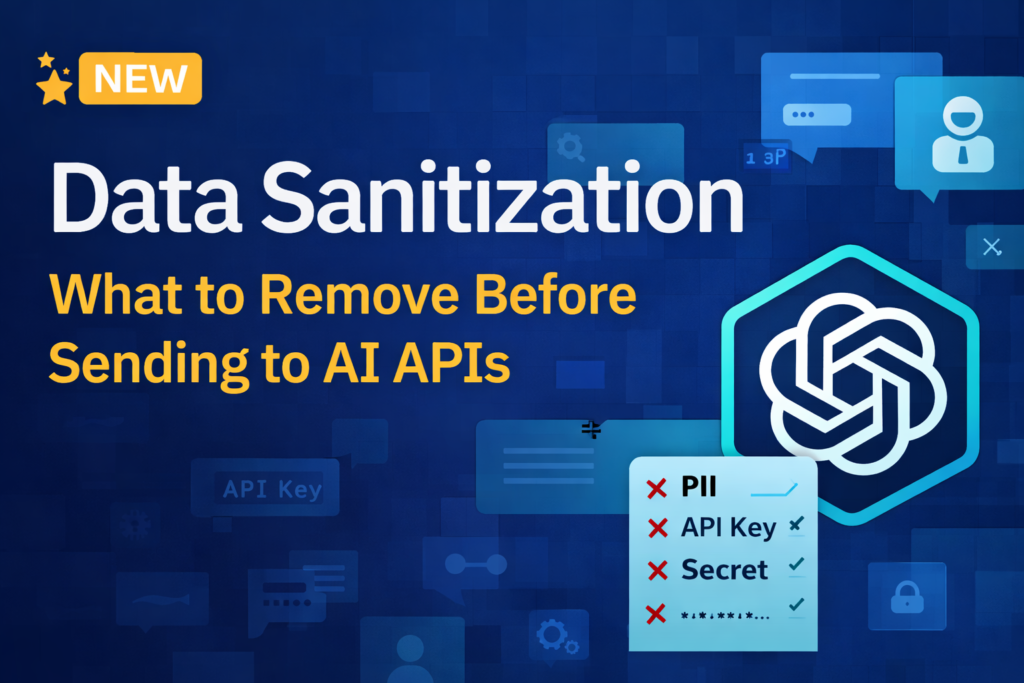
Practical checklist: what to remove before sending to AI APIs
Use this as a pre-send checklist:
Always remove
- ☐ API keys, tokens, passwords, cookies
- ☐ Email addresses, phone numbers, home addresses
- ☐ Full names (unless necessary), customer identifiers
- ☐ Private repo links, internal hostnames, server paths
- ☐ Raw logs with headers, auth, or query params
- ☐ Unreleased product info, contracts, customer lists
Minimize
- ☐ Long documents (send only relevant excerpts)
- ☐ Large code blocks (send the function, not the repo)
- ☐ Full conversations (summarize and redact)
Guard against
- ☐ Prompt injection instructions from pasted content
- ☐ Requests to reveal system prompts or secrets
A simple redaction format that works well
Use consistent placeholders so the model can still reason:
[NAME],[EMAIL],[PHONE][API_KEY_REDACTED][ADDRESS_REDACTED][COMPANY],[PRODUCT],[INVOICE_ID]
This keeps structure while reducing risk.
Final thought: sanitize early, not at the last second
The safest pattern is sanitizing at the boundary—right where data enters your system (forms, uploads, logs) and again before sending outbound to AI APIs. When you do it that way, you stop accidental leaks and you build user trust.
If you’re building automations that chain multiple tools, sanitization becomes even more important because the same data gets copied repeatedly.
Internal link: https://tooltechsavvy.com/how-to-automate-your-workflow-with-make-com-and-ai-apis/