
Artificial intelligence is no longer a futuristic concept—it’s actively reshaping how businesses operate, compete, and deliver value to customers. However, understanding AI’s practical applications can be overwhelming given the technology’s vast potential.
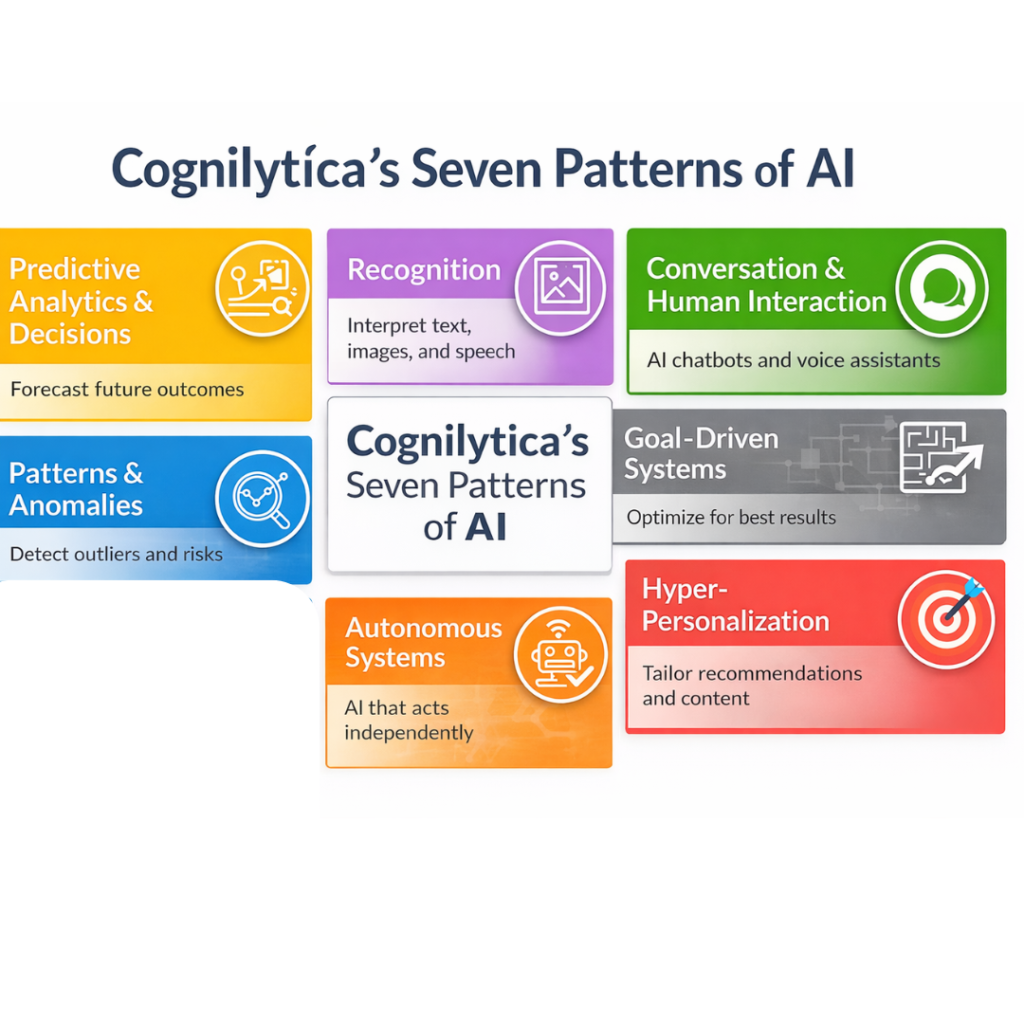
Fortunately, industry experts at Cognilytica have identified seven distinct patterns that categorize how AI is being deployed across industries. These patterns provide a framework for business leaders to identify opportunities and implement AI strategically. Let’s explore each pattern and examine how they’re transforming the business landscape.
1. Hyperpersonalization: Making Every Customer Feel Unique
The first pattern focuses on tailoring experiences to individual users with unprecedented precision. Unlike traditional segmentation that groups customers into broad categories, AI-driven hyperpersonalization analyzes individual behavior, preferences, and context in real-time.
For instance, streaming platforms don’t just recommend content based on your genre preferences—they consider viewing time, completion rates, device usage, and even pausing patterns. Similarly, e-commerce platforms dynamically adjust product recommendations, pricing, and promotional offers based on browsing history and purchasing behavior.
Businesses implementing this pattern see remarkable results. Consequently, companies report increased customer engagement, higher conversion rates, and improved customer lifetime value. The technology behind hyperpersonalization includes machine learning algorithms, collaborative filtering, and deep learning neural networks.
2. Autonomous Systems: AI That Operates Independently
Moving beyond assistance, autonomous systems represent AI that can function without human intervention. These systems make decisions, execute actions, and adapt to changing conditions independently.
The most visible example is self-driving vehicles, but autonomous systems extend far beyond transportation. In warehouses, autonomous robots navigate spaces, pick items, and optimize inventory placement. Meanwhile, in finance, algorithmic trading systems execute thousands of transactions per second based on market conditions.
Nevertheless, successful autonomous systems require robust safety mechanisms, extensive testing, and clear operational boundaries. Businesses must balance autonomy with accountability, ensuring systems can escalate critical decisions to humans when necessary.
3. Predictive Analytics & Decision Support: Forecasting the Future
This pattern leverages historical data to forecast future outcomes and empower better decision-making. Rather than replacing human judgment, predictive analytics augments it with data-driven insights.
Financial institutions use predictive models to assess credit risk and detect fraudulent transactions before they complete. Additionally, retail businesses forecast demand to optimize inventory levels, reducing both stockouts and excess inventory costs. Healthcare providers predict patient readmission risks, enabling preventive interventions.
The competitive advantage here is substantial. Organizations using predictive analytics make faster, more accurate decisions compared to those relying solely on intuition or lagging indicators. Furthermore, these systems continuously improve as they process more data, creating a compounding advantage over time.
4. Conversational AI: Natural Human-Machine Interaction
The fourth pattern focuses on enabling natural language interaction between humans and machines. Conversational AI has evolved dramatically from rigid, rule-based chatbots to sophisticated systems that understand context, intent, and nuance.
Modern virtual assistants handle complex customer service inquiries, schedule appointments, process orders, and even provide technical troubleshooting. Moreover, they operate 24/7 across multiple channels—websites, mobile apps, messaging platforms, and voice interfaces.
Businesses benefit from reduced operational costs while simultaneously improving customer satisfaction through instant, consistent responses. However, successful implementation requires careful design of conversation flows, integration with backend systems, and clear escalation paths to human agents for complex issues.
5. Pattern Recognition & Classification: Finding Meaning in Data
This pattern involves identifying patterns within data to categorize, detect, or recognize specific elements. It’s the foundation of many visible AI applications, from facial recognition to medical image analysis.
In manufacturing, computer vision systems inspect products for defects with greater consistency and speed than human inspectors. Meanwhile, in agriculture, drones equipped with pattern recognition identify crop diseases, pest infestations, and irrigation needs across vast fields.
The applications extend to document processing, where AI classifies and extracts information from invoices, contracts, and forms. Consequently, businesses automate data entry, reduce errors, and free employees for higher-value tasks. As you explore these innovations, ToolTechSavvy offers deeper insights into emerging AI technologies.
6. Goal-Driven Systems: Optimizing for Objectives
Goal-driven systems use reinforcement learning to achieve specific objectives through trial, error, and continuous optimization. These systems learn optimal strategies by receiving rewards or penalties based on their actions.
Energy companies deploy goal-driven AI to optimize power grid operations, balancing supply, demand, and costs while maintaining reliability. Similarly, logistics companies use these systems to optimize delivery routes, considering factors like traffic patterns, delivery windows, fuel costs, and vehicle capacity.
Furthermore, in digital marketing, goal-driven systems automatically adjust ad spending, targeting, and creative elements to maximize return on investment. The system learns which combinations produce the best results and continuously refines its approach.
7. Anomaly Detection: Spotting the Unusual
The final pattern focuses on identifying deviations from normal patterns—crucial for security, quality control, and risk management. Anomaly detection systems establish baselines of normal behavior and flag unusual activities that may indicate problems or opportunities.
Cybersecurity teams rely on anomaly detection to identify potential breaches, unusual network traffic, or suspicious user behavior before significant damage occurs. In manufacturing, these systems predict equipment failures by detecting subtle changes in vibration patterns, temperature, or performance metrics.
Similarly, financial institutions monitor transactions for unusual patterns that might indicate money laundering or fraud. The advantage of AI-powered anomaly detection is its ability to identify novel threats that don’t match known attack signatures or fraud patterns.
Implementing AI Patterns in Your Business
Understanding these seven patterns is the first step. The next is identifying which patterns align with your business challenges and opportunities. Most successful AI initiatives don’t implement all patterns simultaneously but rather focus on one or two that address pressing needs or create competitive advantages.
Start by assessing your business processes, customer pain points, and strategic objectives. Then, map these against the seven patterns to identify the best fit. Additionally, consider your data readiness, technical infrastructure, and organizational capability to support AI implementation.
Remember that AI implementation is a journey, not a destination. As systems learn and improve, businesses often expand from one pattern to multiple patterns, creating integrated AI ecosystems that transform entire business models.
Stay Ahead of the AI Revolution
The seven patterns of AI provide a practical framework for understanding and implementing artificial intelligence in business contexts. From creating personalized customer experiences to detecting anomalies that prevent fraud, these patterns are already delivering measurable value across industries.
As AI technology continues to evolve at a rapid pace, staying informed about these developments is crucial for business leaders, entrepreneurs, and technology professionals. For regular updates on AI trends, practical implementation guides, and cutting-edge innovations transforming the business world, follow ToolTechSavvy.com for comprehensive AI-related content that keeps you at the forefront of technological advancement.