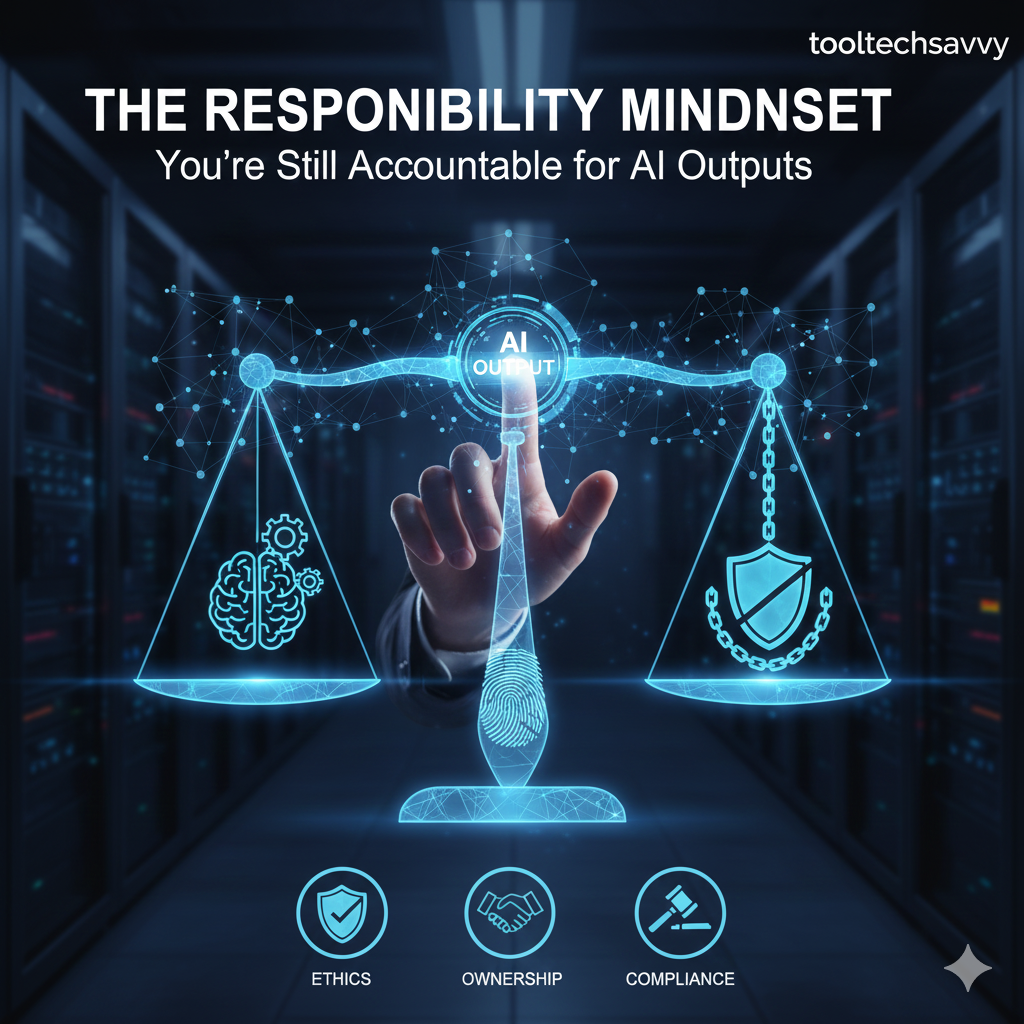
AI tools have transformed how we write, code, research, and create. But as LLMs become deeply embedded in our workflows, one truth becomes impossible to ignore: you are still responsible for everything your AI produces.
This shift—from passive user to accountable operator—is what I call The Responsibility Mindset.
It’s not enough to rely on models for answers. You must also verify, refine, contextualize, and ethically evaluate those answers. And as agentic AI systems automate more workflows end-to-end, your accountability grows even stronger.
For readers new to AI workflows, foundational guides like
ChatGPT for Beginners: 7 Easy Ways to Boost Productivity
and
7 Proven ChatGPT Techniques Every Advanced User Should Know
can provide the perfect starting point.
Why the Responsibility Mindset Matters in an AI-Driven World
LLMs aren’t just autocomplete engines—they’re decision-shaping tools. When you ask them to draft emails, generate code, summarize documents, or analyze data, you’re delegating mental work. Yet delegation does not equal abdication.
You remain responsible for:
- Accuracy — LLM outputs can hallucinate confidently.
- Ethical boundaries — AI may unintentionally generate harmful or biased results.
- Legal compliance — Copyright, privacy, and data handling rules still apply.
- Clarity of instructions — Poor prompts lead to risky outputs.
Transitioning from using AI to supervising AI is the core philosophical shift underlying responsible AI adoption.
1. You Own the Prompt — and the Output
LLMs don’t think, reason, or interpret nuance the way humans do. They respond to patterns. That means your prompt shapes everything.
If your instructions are incomplete, ambiguous, or unsafe, the output will be too.
This is why mastering structured prompting approaches—like those explained in
How to Use GPTs Like a Pro: 5 Prompt Patterns That Work
and
5 Advanced Prompt Patterns for Better AI Outputs
is more important than ever.
Your output quality is a reflection of your instructions.
Your compliance level is a reflection of your oversight.
2. Verification Is Not Optional
Even if you rely on AI to accelerate research or coding, human verification is mandatory. AI is a collaborator—not an authority.
Before publishing, sharing, or integrating any AI-generated result, ask:
- Is this factually accurate?
- Does this reflect my standards?
- Is anything missing or misleading?
- Would I stand behind this if asked?
For deeper guidance on avoiding errors in complex tasks, see
Understanding Context Windows: Why ChatGPT Forgets Things
3. You’re Accountable for Safety, Even if AI Made the Suggestion
AI doesn’t commit wrongdoing—people do, through misuse or misunderstanding.
This is why developers, marketers, writers, and founders must adopt a safety-by-design approach:
- Avoid harmful requests
- Use guardrails in prompts
- Apply ethical redirection
- Maintain transparency that content was AI-assisted
- Avoid generating sensitive or regulated material without review
If you need a primer on how AI guardrails and safety constraints impact workflows,
The Agentic AI Framework Comparison
offers detailed insights.
4. Tools Don’t Replace Judgment — They Enhance It
Yes, AI tools can outperform humans in speed and scale. But they lack:
- lived experiences
- real-world context
- moral reasoning
- accountability
That’s why your judgment remains irreplaceable.
Automation frameworks—like Zapier workflows, copilots, and AI agents—can offload routine tasks, but you must still supervise outputs. Learn how these automations work with:
How to Use Zapier Filters and Paths for Complex Automations
How to Build Complex Workflows with AI Copilots
A responsible operator understands the mechanism, not just the outcome.
5. The Responsibility Mindset Enables Better Results
Ironically, when you take full responsibility for AI outputs, your results get dramatically better.
Why?
Because you:
- Prompt more clearly
- Verify more consistently
- Review more thoughtfully
- Understand limitations more deeply
- Catch hallucinations early
- Build workflows intentionally instead of reactively
This mindset aligns with the emerging agentic AI era described in: How to Adopt the Agentic AI Mindset in 2025
Example: Responsibility in Action
Imagine asking an AI to summarize a 40-page research report. The model gives you a polished summary — but what if:
- The data was outdated?
- The tone misrepresented the findings?
- Key insights were omitted?
- Numerical values were approximated incorrectly?
If you publish that summary, you are responsible — not the model.
This is why a responsible workflow pairs AI acceleration with human validation.
Final Thoughts: AI Changes Work, Not Accountability
AI is not removing responsibility from human hands — it’s shifting it.
Creators who adopt The Responsibility Mindset will thrive. Those who treat AI like a shortcut or authority will eventually face consequences in trust, accuracy, and compliance.
Whether you’re building agents, automating workflows, creating AI content, or using copilots, remember:
AI amplifies your capabilities — but your responsibility stays the same.