Artificial intelligence development doesn’t start with models—it starts with where you build them.
Your development environment shapes how fast you experiment, how easily you collaborate, and how smoothly ideas move from notebook to production.
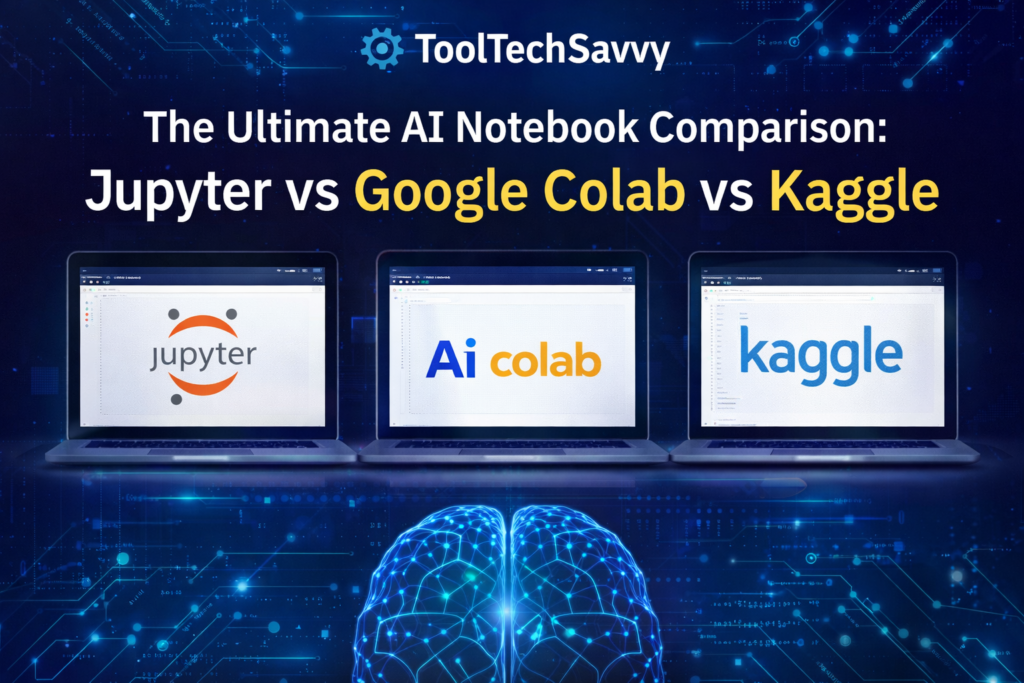
For most developers and learners today, three platforms dominate the conversation:
- Jupyter Notebook
- Google Colab
- Kaggle Notebooks
Each serves a different purpose. Choosing the right one can save hours of friction—and choosing the wrong one can quietly stall your progress.
Let’s break them down clearly, practically, and without hype.
Why Your AI Development Environment Matters
Before comparing tools, it’s worth understanding why this choice matters.
Modern AI workflows involve:
- Iterative experimentation
- Data exploration
- Prompt testing
- Model evaluation
- Collaboration and reproducibility
If you’re just starting out with AI tools, environments like notebooks pair perfectly with beginner-friendly workflows such as those outlined in ChatGPT for Beginners: 7 Easy Ways to Boost Productivity with AI
https://tooltechsavvy.com/chatgpt-for-beginners-7-easy-ways-to-boost-productivity-with-ai/
As you scale, however, your environment must keep up with automation, experimentation speed, and cost control.
Jupyter Notebook: Maximum Control, Maximum Responsibility
Jupyter Notebook is the original foundation of modern AI experimentation.
What Jupyter Does Best
- Runs locally on your machine
- Full control over Python environments
- Ideal for reproducible research
- Works seamlessly with custom ML pipelines
This makes Jupyter a favorite for developers who value privacy, offline access, and environment control—especially when working with sensitive datasets or local models.
If you’re experimenting with open-source AI stacks or local inference setups, Jupyter pairs well with workflows discussed in
How to Set Up a Local AI Development Environment in 2025
https://tooltechsavvy.com/how-to-set-up-local-ai-development-environment-in-2025/
Where Jupyter Falls Short
- No built-in GPUs
- Manual environment setup
- Collaboration requires extra tooling
- Hardware limitations depend on your machine
Best for:
AI engineers, researchers, and developers working locally or preparing production-grade workflows.
Google Colab: Fast Experimentation, Zero Setup
Google Colab lowers the barrier to AI development dramatically.
You open a browser, start coding, and immediately get access to GPUs or TPUs—no installation required.
Why Colab Is So Popular
- Free GPU access (with limits)
- Preinstalled ML libraries
- Easy sharing and collaboration
- Integrated with Google Drive
Colab is particularly useful when paired with prompt experimentation, API testing, and quick demos, similar to workflows covered in
Step-by-Step: How to Experiment With Open-Source AI Models Using Free Tools
https://tooltechsavvy.com/step-by-step-how-to-experiment-with-open-source-ai-models-free-tools/
Limitations You Should Know
- Sessions time out
- Limited RAM and disk
- Not suitable for long-running jobs
- Less control over environment versions
Best for:
Students, educators, rapid prototyping, and short-term experiments.
Kaggle Notebooks: Data-Centric AI Development
Kaggle is often misunderstood as just a competition platform. In reality, its notebook environment is one of the most underrated AI development tools.
Where Kaggle Excels
- Free GPUs and TPUs
- Massive built-in datasets
- Public notebooks for learning
- Strong community feedback loop
Kaggle encourages learning by example, making it ideal if you’re building intuition around models, metrics, and datasets.
If you’re interested in how AI experimentation connects to real-world performance and benchmarks, Kaggle-style workflows align closely with topics explored in
Zero-Shot vs Few-Shot: Real-World Performance Benchmarks for LLMs
https://tooltechsavvy.com/zero-shot-vs-few-shot-real-world-performance-benchmarks-for-llms/
Trade-offs
- Internet access restrictions
- Less flexible filesystem
- Primarily designed for public or shared work
Best for:
Data scientists, competition participants, and hands-on learners.
Side-by-Side Comparison
| Feature | Jupyter | Google Colab | Kaggle |
|---|---|---|---|
| Setup | Manual | None | None |
| GPU Access | Local only | Free (limited) | Free |
| Collaboration | External tools | Built-in | Built-in |
| Dataset Access | Manual | Upload / Drive | Built-in datasets |
| Privacy | High | Medium | Low |
| Best Use Case | Production prep | Rapid experiments | Data-driven learning |
Which One Should You Choose?
Instead of asking which is best, ask what you’re optimizing for.
- Learning AI from scratch? → Google Colab or Kaggle
- Working with large datasets? → Kaggle
- Building private or production-ready systems? → Jupyter
- Testing prompts, APIs, or agent workflows quickly? → Google Colab
As your skills mature, many developers naturally evolve toward hybrid workflows—experimenting in Colab, validating in Kaggle, and productionizing in Jupyter.
This progression mirrors how developers move from experimentation to deployment, as explained in
How to Deploy AI Agents for Everyday Tasks (Free Tools)
https://tooltechsavvy.com/how-to-deploy-ai-agents-for-everyday-tasks-free-tools/
The Bigger Picture: Environment Is Strategy
Your AI environment isn’t just a tool—it’s a strategic choice.
It affects:
- How fast you iterate
- How safely you handle data
- How easily you collaborate
- How smoothly you scale
As AI workflows increasingly involve agents, automation, and multi-step reasoning, choosing the right environment becomes even more critical—especially when combined with emerging practices like those discussed in
Big Tech and Agentic AI: What It Means for You
https://tooltechsavvy.com/big-tech-and-agentic-ai-what-it-means-for-you/
Final Thoughts
Jupyter, Google Colab, and Kaggle aren’t competitors—they’re complements.
The smartest AI developers don’t pick one forever. They choose the right environment for the job at hand.
If you’re building your AI skills in 2025, mastering these environments is just as important as understanding models themselves.
For more practical AI guides, tools, and real-world workflows, explore more at ToolTechSavvy
https://tooltechsavvy.com/