AI feels cheap—until it isn’t.
Many teams enthusiastically adopt AI tools, only to discover unexpected bills a few weeks later. The culprit isn’t always the model itself. More often, it’s a lack of understanding of token economics—how AI systems actually price computation.
In this guide, we’ll break down how token-based pricing works, how to calculate your real AI costs, and practical ways to optimize token usage without sacrificing output quality.
What Are Tokens (And Why They Matter)?
In simple terms, tokens are chunks of text that AI models read and generate. Every prompt you send and every response you receive is measured in tokens.
If you’re new to this concept, this clear explainer on token limits and prompt sizing shows why tokens—not requests—drive cost.
Tokens Include:
- System prompts
- User input
- Retrieved context (RAG)
- Model output
In other words, everything counts.
Why Token Costs Spiral So Fast
At first, costs look negligible. However, things change quickly when you introduce:
- Long system prompts
- Retrieval-augmented generation
- Multi-step agents
- Automation workflows
This is especially common when teams move from experimentation to automation using tools like Zapier. If you’ve built AI workflows before, how to automate with ChatGPT and Zapier shows how easily token usage can multiply.
How to Calculate Your Real AI Costs
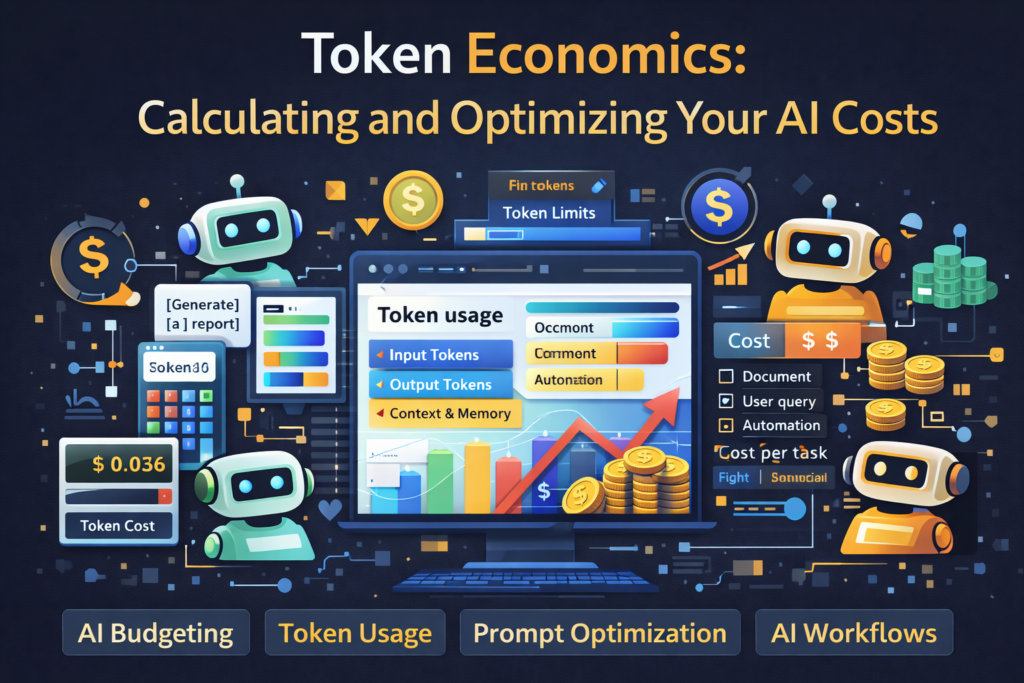
To understand token economics, you need to calculate cost per task, not cost per request.
Step 1: Measure Average Token Usage
Track:
- Input tokens per request
- Output tokens per response
- Extra tokens from context or memory
Step 2: Multiply by Pricing
Each model has different token pricing. Higher-end models cost more per 1K tokens but may reduce retries and hallucinations.
If you’re unsure how to choose wisely, how to choose the right AI model for your workflow helps balance quality and cost.
Step 3: Calculate Cost per Outcome
Instead of asking “How much per call?”, ask:
- Cost per document processed
- Cost per successful automation
- Cost per resolved user query
This shift alone often reveals hidden inefficiencies.
The Hidden Cost Drivers Most Teams Miss
1. Prompt Bloat
Long, repetitive prompts quietly inflate costs.
This is why advanced teams rely on prompt version control instead of endlessly expanding instructions.
2. Hallucination Retries
Every incorrect answer costs you twice:
- Once for the bad output
- Again for the correction
Understanding why AI hallucinates is not just about quality—it’s about cost control.
3. Over-Using Large Models
Bigger models aren’t always better.
For many tasks, smaller or local models are sufficient. This comparison of Ollama vs LM Studio shows when local inference can drastically reduce costs.
Optimizing Token Usage Without Hurting Quality
1. Trim Context Aggressively
Only include what the model actually needs.
If you’re using document search, apply tighter retrieval logic. This guide on improving AI with retrieval-augmented generation explains why fewer, better chunks outperform massive context windows.
2. Use Prompt Chaining Instead of One Giant Prompt
Breaking tasks into smaller steps often reduces total token usage.
This approach is covered in prompt chaining with real-world examples and is especially effective in automation workflows.
3. Cache Stable Responses
If the same prompt appears repeatedly, caching saves tokens instantly.
This optimization is a core part of batching and caching AI workflows.
4. Match Model Size to Task
Use:
- Smaller models for classification or formatting
- Larger models for reasoning and synthesis
Understanding model parameters like 7B, 13B, and 70B helps prevent overpaying for unnecessary capability.
Token Economics in Agentic Systems
Agent-based workflows introduce a new layer of cost complexity.
Each agent:
- Has its own prompt
- Consumes tokens independently
- May loop or retry
If you’re building agents, beginner guides to AI agents emphasize why monitoring token usage per agent is critical.
Monitoring Cost Is Part of AI Performance
Token economics isn’t just finance—it’s performance monitoring.
If you’re already tracking latency and quality, cost metrics should live alongside them. This is why monitoring AI performance metrics includes token usage as a first-class signal.
Common Token Cost Mistakes to Avoid
Teams often overspend when they:
- Optimize prompts once and never revisit them
- Ignore retry loops
- Default to premium models everywhere
- Skip cost alerts entirely
Remember, AI doesn’t fail loudly—it drains budgets quietly.
Final Thoughts: Treat Tokens Like Compute, Not Text
Token economics forces a mindset shift.
AI isn’t priced per conversation—it’s priced per computation. Once you treat tokens like CPU cycles, optimization becomes second nature.
Start by:
- Measuring real usage
- Right-sizing models
- Reducing unnecessary context
- Designing cost-aware workflows
For more practical guides on AI workflows, cost optimization, and real-world implementation, explore https://tooltechsavvy.com/ and build AI that scales sustainably—not surprisingly.