Transformers didn’t become the foundation of modern AI because they’re mysterious—they won because they’re efficient at focusing on what matters.
That “focus” is powered by a concept called attention.
If you’ve ever wondered how models like ChatGPT keep track of context, connect ideas across a paragraph, or “choose” which words matter most, this is the mechanism doing the heavy lifting.
And once you truly understand attention, a lot of AI buzzwords suddenly become… understandable.
What Is Attention in Simple Terms?
Attention is the model’s way of answering one question repeatedly:
“Given what I’m processing right now, which parts of the input should I pay the most attention to?”
In older NLP systems, text was processed sequentially, which created bottlenecks and made long-range relationships hard to learn. Transformers flipped that: instead of moving word-by-word, they evaluate relationships between all tokens at once.
That is exactly what attention computes: token-to-token relevance.
Why Attention Is the “Heart” of Transformers
The Transformer architecture is built on a simple but powerful idea:
- Represent each token
- Let every token “look at” every other token
- Mix information based on relevance
- Repeat across multiple layers
This is why Transformers scale so well and why they outperform many earlier architectures on language tasks.
If you’re curious about how these models are evolving and why they’re now used everywhere, this broader explainer connects the dots nicely:
https://tooltechsavvy.com/why-big-tech-is-betting-everything-on-the-next-ai-model/
The Core Pieces: Query, Key, and Value
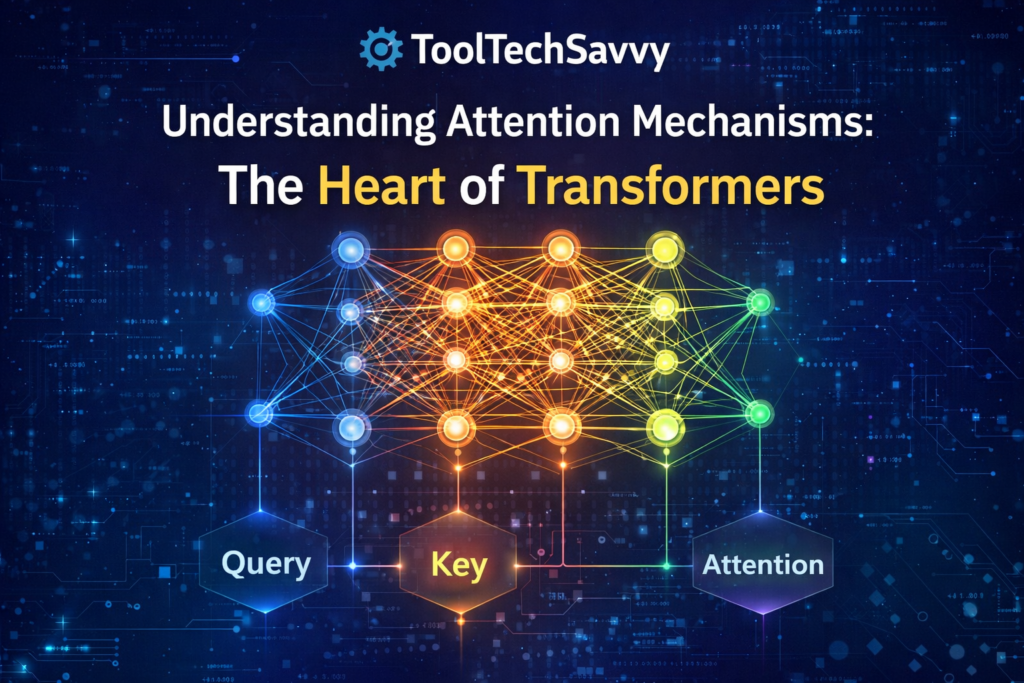
Self-attention is often explained using Q, K, V:
- Query (Q): what this token is looking for
- Key (K): what each other token offers
- Value (V): the actual information to pull in if relevant
In practice:
- Each token creates its own Q, K, and V vectors.
- The token compares its Query against all Keys.
- The comparison scores become “attention weights.”
- Those weights blend the Values into a new, context-aware representation.
So attention isn’t “magic”—it’s vector math that decides relevance.
How Self-Attention Actually Works (Step-by-Step)
Here’s the workflow in plain English:
1) Compute similarity scores
For a token, compare its Query with every other token’s Key.
2) Normalize scores into probabilities
Use a softmax so all scores become weights that add up to 1.
3) Weighted sum of Values
Multiply each token’s Value by its weight and sum them up.
The output is a new token representation enriched with context.
This is how “bank” becomes river bank in one sentence and money bank in another—attention learns which surrounding tokens are relevant.
Multi-Head Attention: Multiple “Lenses” at Once
Transformers don’t run attention once. They run it in parallel using multiple heads.
Each head can specialize:
- One head focuses on syntax (subject/verb relationships)
- Another tracks entities (people, objects)
- Another captures long-range dependencies
This is part of why Transformers are both powerful and flexible.
If you’ve ever noticed that prompt quality changes outputs drastically, it’s because attention patterns shift depending on how you structure inputs—this pairs well with:
https://tooltechsavvy.com/how-to-use-gpts-like-a-pro-5-role-based-prompts-that-work/
Attention vs “Reasoning” (Important Distinction)
Attention helps the model connect relevant information—but attention alone isn’t “reasoning” in the human sense.
A useful mental model:
- Attention = information routing
- Layers + training = learned patterns
- Inference = pattern completion under constraints
This becomes especially clear when you see hallucinations: the model can attend to the right context and still generate a confident wrong answer.
To understand why this happens (and how to reduce it), read:
https://tooltechsavvy.com/understanding-ai-hallucinations-why-ai-makes-things-up/
Why Attention Matters for Real AI Workflows
Understanding attention isn’t just academic. It helps you:
Write better prompts
Clear structure guides attention to the right tokens and reduces ambiguity.
Practical upgrade:
https://tooltechsavvy.com/5-advanced-prompt-patterns-for-better-ai-outputs/
Make smarter model choices
Not every model handles long context equally, and attention cost scales with sequence length. That’s why context limits and token budgeting matter.
Related guide:
https://tooltechsavvy.com/token-limits-demystified-how-to-fit-more-data-into-your-llm-prompts/
Build safer systems
Attention patterns can be exploited with prompt injection and instruction hijacking, especially when models must follow both system and user messages.
Essential read:
https://tooltechsavvy.com/prompt-injection-attacks-what-they-are-and-how-to-defend-against-them/
The Big Constraint: Attention Gets Expensive
Classic self-attention scales roughly with:
- O(n²) with respect to sequence length (n tokens)
That means long documents become costly, slow, and memory-heavy.
This is why techniques like:
- chunking
- retrieval augmentation
- vector databases
have become standard in real-world systems.
If you’re building assistants that need external knowledge, this is the most practical next step:
https://tooltechsavvy.com/retrieval-augmented-generation-the-new-era-of-ai-search/
And if you want a clearer understanding of embeddings (the foundation of retrieval), start here:
https://tooltechsavvy.com/what-are-embeddings-ais-secret-to-understanding-meaning-simplified/
Attention, RAG, and the Future of Context
When you connect attention with retrieval (RAG), you unlock the modern stack:
- retrieve relevant chunks
- inject them into the prompt
- let attention bind them to the user’s question
That’s the core of “AI search” and many production chatbots today.
Final Takeaway
Attention is the mechanism that lets Transformers:
- model relationships between tokens
- capture context efficiently
- scale to massive datasets and parameters
It’s the “heart” because it decides what information flows forward—layer after layer—until the model produces an output that feels coherent and intelligent.
For more AI guides, workflows, and beginner-to-advanced explainers, visit ToolTechSavvy:
https://tooltechsavvy.com/