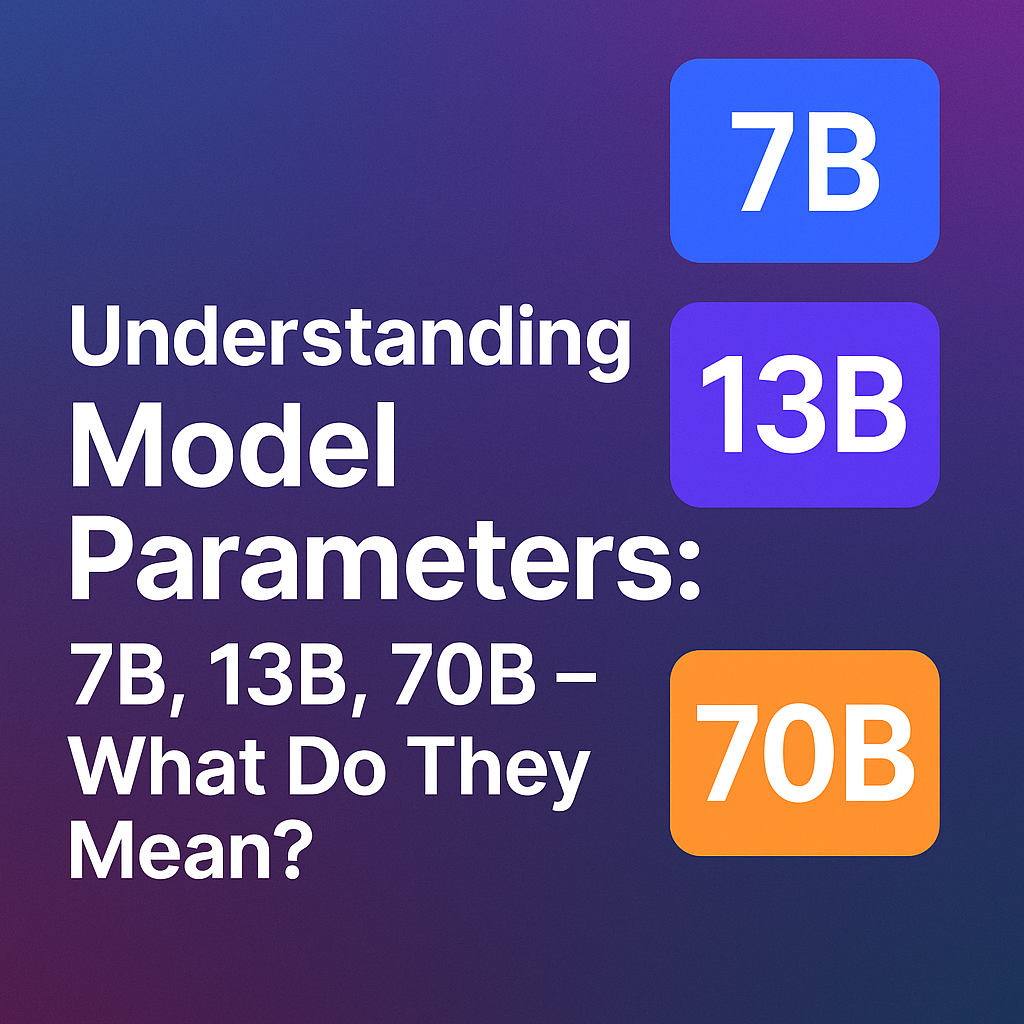
As AI models continue to shape how we work, create, and code, you’ll often see terms like 7B, 13B, or 70B included in model names. These numbers refer to the number of parameters—the internal “weights” a model uses to learn patterns and generate responses.
But what do these parameter sizes actually mean for everyday users? Do bigger models always perform better? And how do you choose the right one for your workflow?
In this guide, we break down parameter counts in a clear, practical way, building on related concepts like understanding context windows (see: Why ChatGPT Forgets Things) and choosing the right AI model (see: How to Choose the Right AI Model for Your Workflow).
What Are Parameters in AI Models?
In simple terms, parameters are the mathematical values inside a model that determine how it processes information. Think of them as the “knowledge configuration” that shapes:
- reasoning ability
- pattern recognition
- accuracy
- creativity
- memory-like behavior
- problem-solving
A model with more parameters generally has more capacity to:
- learn complex patterns
- understand nuanced context
- generate higher-quality responses
This is why parameter count often correlates with model capability—though it’s not the only factor.
If you’re new to how AI models work internally, you may want to explore:
Model Sizes Explained: 7B, 13B, 70B
Let’s break down the differences.
7B Models — Lightweight and Fast
A 7 billion-parameter model sits in the “small to medium” category. These models offer:
- Fast response generation
- Low memory requirements
- Great for edge devices or local use (see: Ollama vs LM Studio)
- Lower cost for API usage
Best for:
- Basic Q&A
- Summaries
- Simple coding tasks
- On-device workflows
- Projects sensitive to latency or cost
13B Models — The Sweet Spot for Many Workflows
13B models often feel like the “just right” option. They offer noticeably stronger reasoning and creativity compared to 7B, without the heavy cost of large models.
Best for:
- Medium coding tasks
- Research support
- Workflow automation
- More nuanced content generation
If you’re exploring agentic workflows, 13B models pair well with:
70B Models — High-End Reasoning and Creativity
A 70 billion-parameter model belongs to the “large model” class. These excel at:
- advanced reasoning
- detailed explanations
- multi-step problem solving
- complex coding
- long-context understanding
They’re ideal when accuracy, depth, or creativity truly matter—especially for tasks like:
- building agents
- constructing RAG systems
- long technical content
- advanced coding assistance
For deeper workflow enhancements, see:
Do Bigger Models Always Perform Better?
Not necessarily.
While bigger models typically understand more context and handle more sophisticated tasks, they also require:
- more compute
- more memory
- higher API costs
- more energy
- longer response times
That’s why Small Language Models (SLMs) have become increasingly popular, as covered in:
Small Language Models: When Bigger Isn’t Better
Today, smart model selection is about matching capability to the task, not always choosing the largest model available.
How Model Size Impacts Performance
1. Reasoning & Problem-Solving
Larger models (e.g., 70B) outperform smaller ones significantly in logic-heavy tasks.
2. Creativity & Writing Quality
Creative writing improves with size—but 13B can be a sweet spot for balance.
3. Coding & Debugging
Heavier models catch deeper issues, especially in multi-file contexts.
See:
4. Latency & Cost
Smaller models excel when speed and budget matter.
Choosing the Right Model for Your Workflow
Here’s a practical breakdown:
| Task | Best Model Size |
|---|---|
| Quick answers, summaries | 7B |
| Medium complexity tasks | 13B |
| Advanced reasoning, multi-step work | 70B |
| Local model deployment | 7B or 13B |
| RAG systems | 13B or 70B |
| AI agents | 13B or 70B |
For model selection guidance, see:
How to Choose an LLM Agent Architecture
The Future of Model Sizes
As AI evolves, parameter counts may become less important than:
- architecture improvements
- mixture-of-experts models
- hybrid on-device + cloud workflows
- smarter context compression
This hybrid future aligns with:
The Future Is Hybrid
We may soon see 7B models outperform today’s 70B models—thanks to architectural leaps, not brute force size.
Final Takeaway
Model sizes like 7B, 13B, and 70B represent the internal capacity of AI models. Bigger models generally provide better reasoning, depth, and accuracy—but they’re not always the best choice.
Instead, the smartest approach is to match task complexity to model capability, just as you would select the right tool for any job.
With the right model—and the right mindset—you can build faster, smarter, and more scalable AI workflows.