
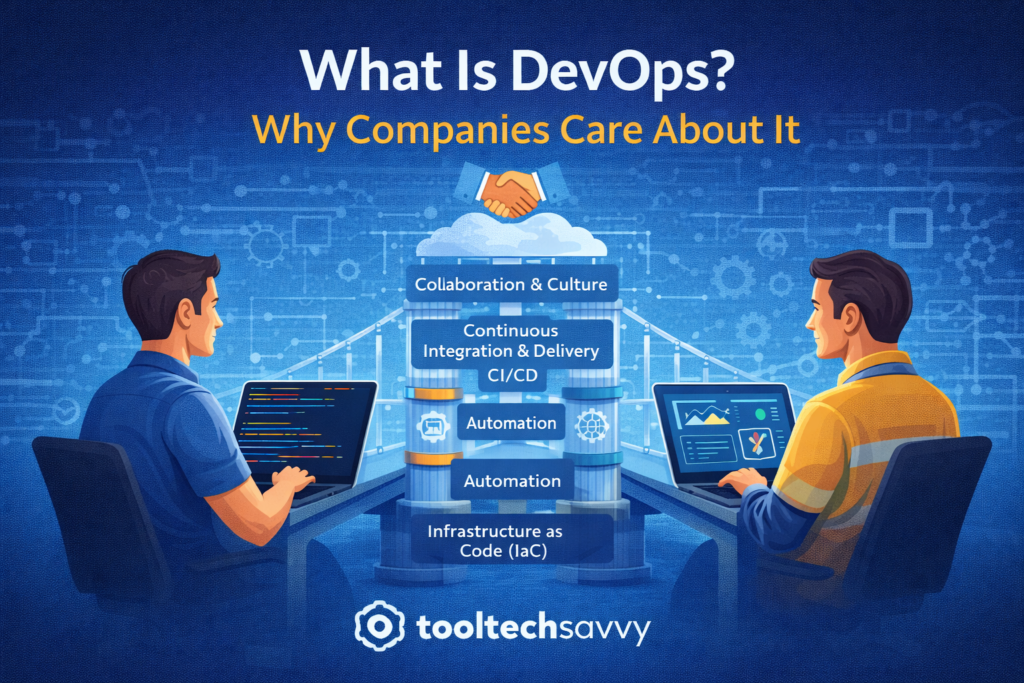
If you’re new to tech, you’ve probably heard the word DevOps everywhere — in job listings, tech blogs, and conversations about modern software. Yet for many beginners, DevOps sounds vague, confusing, or overly complex.
In reality, DevOps is not a single tool or job title. It’s a way of working that has changed how companies build and deliver software. This guide explains DevOps in simple terms and why it has become so important in the tech industry.
What Is DevOps?
DevOps is a combination of Development (Dev) and Operations (Ops).
It represents a set of practices and cultural principles that help software development teams and IT operations teams work together instead of separately.
Traditionally:
- Developers wrote code
- Operations teams deployed and maintained it
- Handoffs were slow and error-prone
DevOps removes these barriers by encouraging collaboration, automation, and shared responsibility across the software lifecycle.
Why DevOps Was Needed
Before DevOps, software delivery was slow and risky.
Common problems included:
- Long release cycles
- Frequent production failures
- Blame between teams
- Manual deployments
- Difficulty scaling systems
As companies started shipping software more frequently — sometimes multiple times a day — this old model simply stopped working.
DevOps emerged as a response to these challenges.
What DevOps Actually Focuses On
DevOps is about how software moves from idea to production.
It focuses on:
- Faster and safer deployments
- Automation instead of manual work
- Continuous testing and integration
- Reliable and scalable systems
- Faster feedback from users
The goal is to deliver value to users quickly while maintaining stability and quality.
Common DevOps Practices Explained Simply
You don’t need to know every tool to understand DevOps. These are the core ideas behind it:
Continuous Integration (CI)
Code changes are tested automatically as soon as they’re added, reducing bugs early.
Continuous Deployment (CD)
Software updates are deployed frequently and safely instead of in large, risky releases.
Automation
Infrastructure, testing, and deployments are handled by scripts and tools instead of manual steps.
Monitoring and Feedback
Teams continuously monitor systems to catch issues early and improve performance.
Why Companies Care About DevOps
Companies invest in DevOps because it directly impacts business outcomes.
DevOps helps companies:
- Release features faster
- Reduce system downtime
- Improve customer experience
- Scale applications smoothly
- Respond quickly to market changes
In competitive markets, speed and reliability are no longer optional — they’re essential.
DevOps Is a Culture, Not Just Tools
One of the biggest misconceptions is that DevOps is only about tools.
In reality, DevOps is about:
- Shared ownership
- Collaboration
- Transparency
- Continuous improvement
Tools support DevOps, but mindset and communication make it successful.
DevOps Roles and Career Paths
DevOps has also created new career opportunities, including:
- DevOps Engineer
- Site Reliability Engineer (SRE)
- Platform Engineer
- Cloud Engineer
These roles blend software development skills with infrastructure, automation, and system reliability.
Do Beginners Need to Learn DevOps?
Yes — at least the fundamentals.
Even if you don’t become a DevOps specialist, understanding DevOps helps you:
- Write deployable code
- Work better in teams
- Understand modern cloud systems
- Become a more effective software engineer
DevOps knowledge is increasingly expected across technical roles.
Final Thoughts
DevOps exists because modern software demands speed, reliability, and collaboration. It helps companies build better software and helps engineers work more efficiently together.
For beginners, DevOps may seem complex at first, but understanding its purpose and principles provides a strong foundation for modern tech careers.
To keep learning — from DevOps fundamentals to advanced topics like AI — explore https://tooltechsavvy.com/.
Visit the blog to discover AI, cloud, software engineering, tools, and other interesting topics designed to support your journey into tech. 🚀