If you’re exploring cloud computing or DevOps, you’ll quickly encounter one name everywhere: Docker. It’s mentioned in job descriptions, tutorials, and tech discussions—but for beginners, it’s not always clear what Docker actually does.
Docker didn’t invent containers, but it made them easy, practical, and mainstream. This article explains what Docker is, how it works, and why developers rely on containers in modern software development.
What Is Docker?
Docker is a tool that allows developers to package applications into containers.
A container includes:
- The application code
- All required libraries and dependencies
- Configuration files
This package can then run consistently across different environments, such as laptops, servers, and cloud platforms.
In simple terms:
Docker helps developers build once and run anywhere.
What Problem Does Docker Solve?
Before Docker, developers often faced this issue:
“It works on my machine, but not on yours.”
Different environments meant:
- Different operating systems
- Different library versions
- Different configurations
Docker solves this by bundling everything an application needs into a container, eliminating environment-related issues.
How Docker Works (Without Jargon)
Docker uses containers, which:
- Share the host operating system
- Isolate applications from each other
- Start quickly
- Use fewer resources than virtual machines
Docker acts as the tooling layer that creates, runs, and manages these containers.
Docker vs Virtual Machines (Quick Recap)
Docker containers:
- Do not include a full operating system
- Are lightweight and fast
- Focus on running applications
Virtual machines:
- Include an entire operating system
- Are heavier and slower to start
- Focus on running full systems
This efficiency is why Docker became so popular.
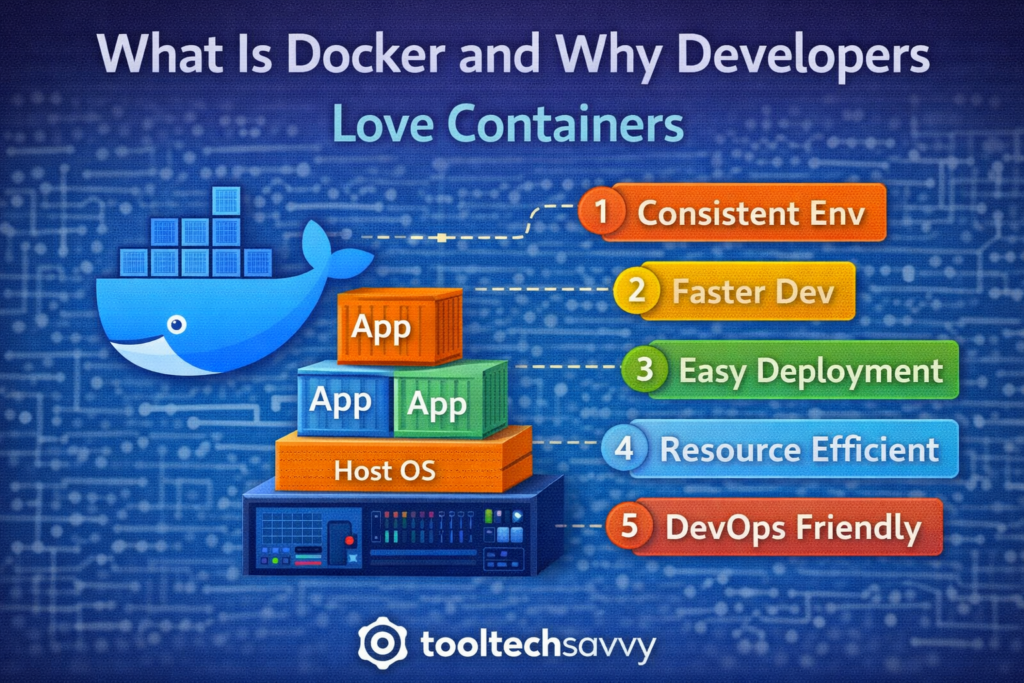
Why Developers Love Docker
1. Consistent Environments
Docker ensures the app behaves the same everywhere—development, testing, and production.
2. Faster Development
Developers can:
- Set up environments quickly
- Share containers easily
- Avoid complex configuration steps
This speeds up onboarding and experimentation.
3. Easy Deployment
Docker containers can be:
- Deployed locally
- Pushed to cloud platforms
- Used in CI/CD pipelines
This makes releases predictable and repeatable.
4. Better Resource Efficiency
Containers use fewer system resources, allowing:
- More apps to run on the same machine
- Faster scaling
- Lower infrastructure costs
5. Strong DevOps and Cloud Integration
Docker fits naturally into:
- CI/CD pipelines
- Cloud platforms
- Microservices architectures
It acts as a bridge between development and operations.
Where Docker Is Commonly Used
Docker is widely used for:
- Web applications
- Microservices
- Development environments
- Automated testing
- Cloud-native applications
Most modern DevOps workflows rely on Docker at some stage.
Is Docker Hard for Beginners?
Docker introduces new concepts, but it’s beginner-friendly when learned step by step.
Beginners should focus on:
- Understanding what containers are
- Learning basic Docker commands conceptually
- Knowing why Docker exists
Hands-on practice can come later once the concepts are clear.
Common Docker Misconceptions
- Docker is not a virtual machine
- Docker does not replace cloud platforms
- Docker is a tool, not an application framework
- Containers still need proper security and management
Clearing these misconceptions early helps avoid confusion.
Docker’s Role in the Bigger Picture
Docker is often used alongside:
- Cloud platforms
- Container orchestration tools
- CI/CD systems
- Monitoring and security tools
Understanding Docker makes advanced DevOps and cloud concepts much easier to learn.
Final Thoughts
Docker changed how software is built and delivered by making containers practical for everyday development. Developers love Docker because it simplifies environments, speeds up workflows, and fits perfectly into modern cloud-native systems.
For beginners, Docker is less about memorizing commands and more about understanding why containers matter.
To continue learning—from Docker fundamentals to advanced topics like AI—visit https://tooltechsavvy.com/.
Explore the blog to discover AI, software engineering, cloud, DevOps, tools, and other interesting topics designed to help you grow confidently in tech.