
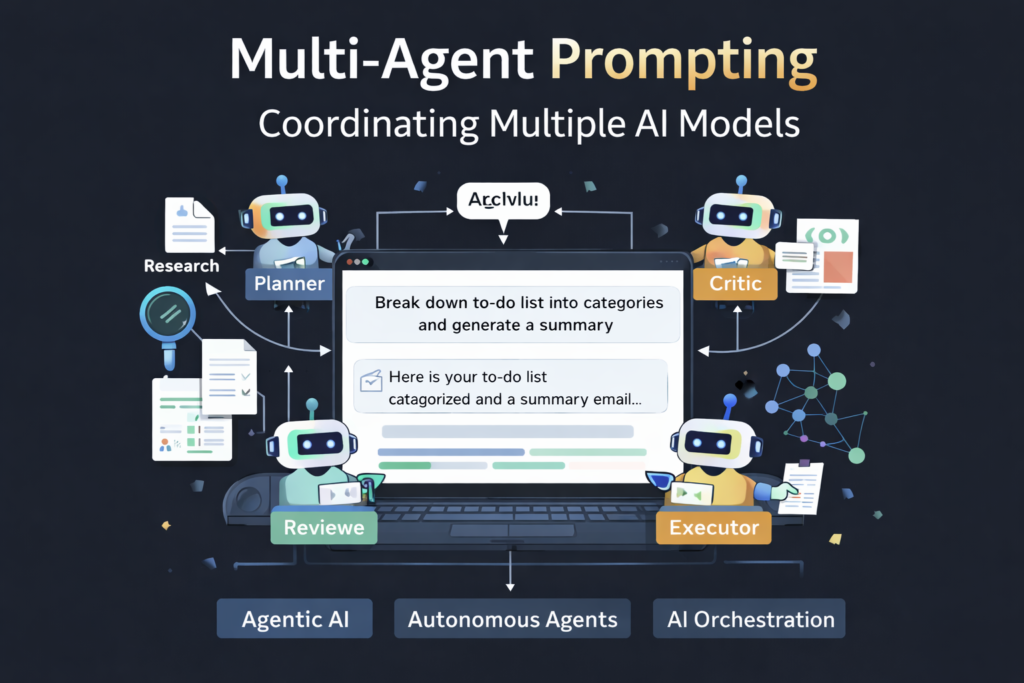
AI is no longer a solo act.
While single-model prompts work for basic tasks, today’s most powerful AI systems rely on multiple models working together—each with a clear role, responsibility, and objective. This approach is known as multi-agent prompting, and it’s quickly becoming the backbone of advanced AI workflows.
In this guide, we’ll break down what multi-agent prompting is, why it matters, and how you can start using it today—even if you’re not an AI engineer.
What Is Multi-Agent Prompting?
Multi-agent prompting is a technique where multiple AI agents or models collaborate to complete a task instead of relying on a single prompt or response.
Each agent typically has:
- A specific role (researcher, planner, critic, executor)
- A clear goal
- A limited scope of responsibility
Rather than asking one model to “do everything,” you coordinate a small AI team.
If role-based prompting sounds familiar, it builds directly on concepts explained in How to Use GPTs Like a Pro: Role-Based Prompts That Work—but taken to the next level.
Why Single-Prompt AI Starts to Break Down
At first, prompting feels magical. However, as tasks grow more complex, problems emerge:
- Responses become shallow or inconsistent
- Long instructions are ignored
- Reasoning collapses under complexity
- Context windows are exhausted
This happens because one model is being forced to plan, reason, execute, and validate all at once.
If you’ve experienced this, understanding why ChatGPT forgets things explains why multi-agent setups are more reliable.
How Multi-Agent Prompting Solves This
Instead of one overworked model, multi-agent prompting creates specialized intelligence.
For example:
- Agent 1: Breaks the task into steps
- Agent 2: Executes each step
- Agent 3: Reviews and critiques
- Agent 4: Refines the final output
This mirrors how humans work in teams—and the results are significantly better.
This structured thinking is closely related to prompt chaining with real-world examples, where outputs from one prompt feed into the next.
Common Multi-Agent Architectures
1. Planner → Executor → Reviewer
This is the most popular pattern:
- The planner defines strategy
- The executor performs the work
- The reviewer catches errors and improves quality
This aligns well with agentic workflows, covered in Beginner’s Guide to AI Agents.
2. Research Agent + Reasoning Agent
One agent gathers facts, while another synthesizes insights.
This pattern is especially powerful when combined with retrieval-augmented generation, explained in Retrieval-Augmented Generation: The New Era of AI Search.
3. Tool-Using Agent Teams
Some agents specialize in:
- APIs
- Search
- Code execution
- Summarization
Modern frameworks such as LangChain support this approach, as shown in Introduction to LangChain Agents.
Real-World Use Cases for Multi-Agent Prompting
Multi-agent prompting isn’t theoretical—it’s already everywhere.
Content & Research
- One agent researches
- One drafts
- One edits
- One optimizes for SEO
This improves consistency and accuracy, especially for long-form content.
Automation & Workflows
When paired with automation tools, multi-agent systems can run end-to-end processes.
If you’re exploring no-code setups, Notion, Zapier, and ChatGPT workflows show how agents can collaborate across tools.
Coding & Development
- One agent designs logic
- One writes code
- One reviews for bugs
- One optimizes performance
This approach fits naturally with AI copilots, discussed in AI Copilot Updates 2025.
How to Start Using Multi-Agent Prompting (Beginner Friendly)
You don’t need advanced infrastructure to begin.
Step 1: Define Clear Roles
Avoid vague prompts. Instead, assign identities:
- “You are a planning agent…”
- “You are a critical reviewer…”
This builds on techniques from From Generic to Expert: Custom System Prompts.
Step 2: Separate Tasks Logically
Don’t mix research, reasoning, and writing in one step. This is a key lesson from Advanced Prompt Patterns.
Step 3: Chain or Orchestrate Responses
Pass structured outputs between agents. Keep instructions short and focused to avoid token waste—see Token Limits Demystified.
Common Mistakes to Avoid
Even powerful setups fail when:
- Agents have overlapping responsibilities
- Instructions conflict
- No validation step exists
- Outputs are trusted blindly
Understanding AI hallucinations is critical when coordinating multiple models.
Why Multi-Agent Prompting Is the Future
As AI systems grow more capable, coordination—not raw intelligence—becomes the bottleneck.
That’s why:
- Big tech is investing heavily in agentic systems
- Open-source frameworks are exploding
- Multi-model orchestration is replacing single-prompt hacks
If you want to stay ahead, adopting the agentic mindset explained in How to Adopt the Agentic AI Mindset in 2025 is essential.
Final Thoughts
Multi-agent prompting transforms AI from a chatbot into a collaborative system.
Instead of asking better questions, you’re designing better teams of intelligence.
And that shift—from prompts to systems—is where real leverage lives.
For more practical guides on AI agents, prompting strategies, and real-world workflows, explore https://tooltechsavvy.com/ and keep building smarter, not harder.