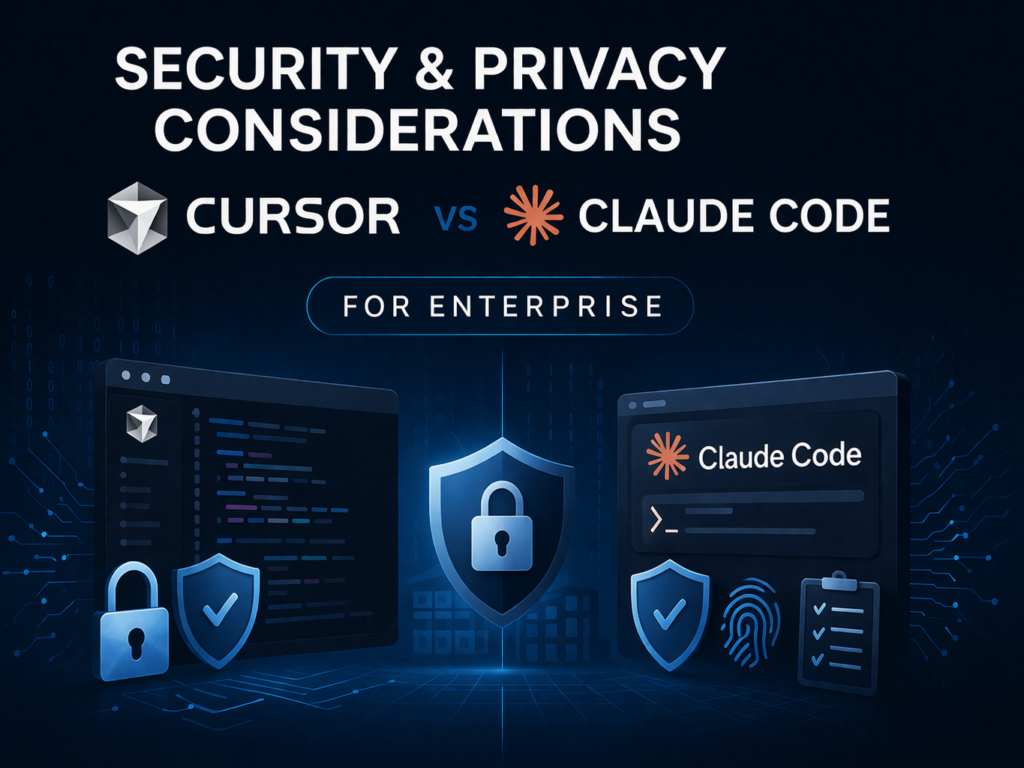
AI coding tools are no longer a nice-to-have — they’re embedded in engineering workflows at scale. But as Cursor and Claude Code earn seats on enterprise laptops, a harder question than “which is better at code?” emerges: which one can your security team actually trust?
When enterprises evaluate AI coding assistants, the conversation usually starts with productivity benchmarks and model quality. But it should start somewhere else entirely — with data flows, compliance posture, and what happens to your proprietary code the moment it leaves your developer’s machine.
Both Cursor and Claude Code are powerful, both are evolving rapidly, and both have earned genuine respect from engineering teams in 2025–2026. But their security architectures, privacy commitments, and enterprise readiness profiles are meaningfully different. If your team ships code that touches sensitive data, regulated industries, or customer PII, those differences matter enormously.
This post breaks down exactly where each tool stands — and what you should be asking before you roll either one out at scale.
01 — Data Handling
Where Does Your Code Actually Go?
This is the first question any enterprise security team should ask, and the answer differs between these two tools in important ways.
Cursor
Cursor operates as a VS Code fork with AI features woven throughout. When you use its AI capabilities, your code snippets — and depending on context, substantial portions of your codebase — are sent to model providers. By default, Cursor routes prompts through its own infrastructure before hitting underlying models (which can include OpenAI, Anthropic, or others depending on settings).
The key enterprise toggle here is Privacy Mode. When enabled, Cursor guarantees that your code is never stored by their model providers or used for training. It’s an important protection, but it requires deliberate activation — it’s not the default for individual users, and ensuring it’s consistently enforced across a distributed team requires admin-level management.
Cursor’s privacy mode is team-plan and above. Individual plan users don’t have centralized enforcement, meaning a single developer forgetting to toggle it on could expose sensitive code. Enterprise rollouts need admin policies in place before day one.
Claude Code
Claude Code operates through Anthropic’s API infrastructure and inherits Anthropic’s privacy policies directly. A critical commitment: by default, Claude Code does not use customer code for training purposes. This is a significant baseline difference — the protection is on by default, not opt-in.
Claude Code also supports deployment through AWS Bedrock and Google Cloud Vertex AI, which gives enterprises with existing cloud infrastructure the ability to route all model calls through their own managed environments. This is a substantial enterprise advantage — it means your code can stay within your existing cloud security boundary rather than transiting Anthropic’s direct API.
Claude Code’s AWS Bedrock and GCP Vertex deployments let enterprises inherit the security controls, VPC configurations, and data residency guarantees of their existing cloud contracts — without needing to negotiate separate data handling agreements with Anthropic.
02 — Compliance Certifications
What the Compliance Alphabet Actually Covers
Both tools have invested seriously in third-party compliance certification. But the depth of coverage differs.
| Compliance Area | Cursor | Claude Code (Anthropic) |
|---|---|---|
| SOC 2 Type II | ✓ Certified | ✓ Certified (Type I & II) |
| ISO 27001 | Not publicly confirmed | ✓ Certified |
| ISO 42001 (AI Mgmt) | Not publicly confirmed | ✓ Certified |
| GDPR Readiness | ✓ Supported | ✓ Supported |
| HIPAA-Ready Config | Limited documentation | ✓ Available on Enterprise |
| SCIM Provisioning | ✓ Enterprise plan | ✓ Enterprise plan |
| SSO / SAML | ✓ Enterprise plan | ✓ Enterprise plan |
ISO 42001 certification is worth highlighting specifically — it’s a relatively new standard focused on AI management systems, covering responsible AI development, risk controls, and governance frameworks. For enterprises in regulated industries, this certification signals a level of AI governance maturity that goes beyond generic cloud security.
03 — Documented Vulnerabilities
Known Security Issues (Because Transparency Matters)
Any honest security assessment has to include documented vulnerabilities. Both tools have accumulated CVEs in 2025–2026 — and how each vendor handled them tells you something important about their security culture.
Cursor
The most significant documented issue is CVE-2025-59944 — a case-sensitivity bypass vulnerability that enabled persistent remote code execution across IDE restarts through MCP (Model Context Protocol) configuration files. The fact that this persisted across restarts made it particularly serious for enterprise environments where developers might not notice an injected configuration.
Claude Code
Claude Code has its own documented vulnerabilities. Research from Check Point documented how malicious .claude/settings.json files could trigger remote code execution and API key theft — a meaningful concern given Claude Code’s broad system access. Two specific CVEs were identified and patched: CVE-2025-59536 (CVSS 8.7, remote code execution via malicious project config, patched in v1.0.111) and CVE-2026-21852 (CVSS 5.3, API key exfiltration, patched in v2.0.65).
Claude Code’s autonomous task execution capability — while powerful for complex refactoring — creates a larger blast radius when compromised. The same agentic power that makes it productive makes security hygiene non-optional.
The key lesson for enterprise security teams: both tools have proven attack surfaces, and both have responded with patches. What this means in practice is that patch management for AI tooling needs to be treated the same as any other software dependency — monitored, enforced, and kept current. Allowing developers to run outdated versions of either tool in a sensitive codebase is a real risk.
04 — Access Controls & Governance
Who Controls What — At Scale
Governance is where enterprise-grade separates from prosumer-grade. The ability to centrally manage policies, audit activity, and enforce least-privilege access across a developer team of 50, 500, or 5,000 is non-negotiable for enterprise security.
Cursor
Cursor’s Business and Enterprise plans include an admin dashboard, SAML authentication, team access controls, and workspace scoping — ensuring that AI context is limited to the appropriate project boundaries. Cursor’s Business plan also centralises billing visibility, which is useful for finance and compliance teams tracking AI spend.
One notable governance feature Cursor has added is workspace scoping, which ensures the AI assistant’s context is restricted to the relevant project and doesn’t inadvertently reference code or data from unrelated workspaces.
Claude Code
Claude Code’s enterprise offering includes SSO integration, role-based permissions, audit logging, and SCIM-based user provisioning. The audit logging capability is particularly relevant for regulated industries — having an immutable log of every AI-assisted code change supports compliance reporting and incident investigation.
Beyond the tool itself, Claude Code’s integration with AWS Bedrock and GCP Vertex means enterprises can layer on the access control infrastructure of their cloud provider — including IAM roles, VPC restrictions, and cloud-native audit trails. For organisations already deeply invested in AWS or GCP security posture, this is a significant governance advantage.
Claude Code’s agentic nature — executing terminal commands, reading entire codebases, managing files — means access control is more consequential than in a traditional code completion tool. Enterprises should define clear policies on which repositories Claude Code agents can access and what system-level actions are permitted.
05 — Model Architecture & Vendor Risk
Single Vendor vs Multi-Model Flexibility
This is a dimension security teams sometimes overlook because it feels like a product feature rather than a security concern. It’s actually both.
Cursor supports multiple model providers — OpenAI, Anthropic, and others — giving teams flexibility to switch models as the landscape evolves. For enterprise security teams, this flexibility introduces a complexity: each model provider has its own data handling terms, and ensuring consistent privacy posture across providers requires ongoing governance work.
Claude Code is locked to Anthropic’s model ecosystem. This constraint, which some developers find limiting, is actually a security and compliance advantage for enterprises. Single-vendor model management means a single data processing agreement, a single compliance audit, a single set of privacy commitments to verify. Anthropic’s enterprise documentation notes that single-vendor model management can meaningfully reduce security audit complexity.
The trade-off is real — if Anthropic’s models degrade in quality or availability, Claude Code users have no fallback. But for organisations where compliance simplicity and auditability outweigh model flexibility, the single-vendor architecture is a feature, not a bug.
06 — Practical Enterprise Guidance
What Should Your Security Team Actually Do?
Best for compliance-heavy environments
Healthcare, finance, regulated industries, and teams where HIPAA, SOC 2, or ISO certification is audited. Strong default privacy, cloud deployment flexibility, and deeper certification stack.
Best for teams prioritising editor experience
Product and application teams where developer flow matters, privacy mode is centrally enforced, and model flexibility is valued over single-vendor simplicity.
Regardless of which tool you choose, your enterprise security team should have answers to these questions before wide deployment:
- Is privacy mode or equivalent data retention protection enforced by policy, not just available as an option?
- Are AI tool versions centrally managed and kept up to date? (CVEs in both tools require prompt patching.)
- Do you have audit logging configured to capture AI-assisted changes to sensitive codebases?
- Are repository access scopes defined — can Claude Code agents access only the repositories they should?
- Have you reviewed the data processing agreements with each tool’s model providers?
- Is your team aware of prompt injection risks, particularly for Claude Code’s agentic workflows reading external files or web content?
The Bottom Line for Enterprise
- Claude Code has a stronger out-of-the-box compliance posture — default no-training commitment, deeper certification coverage, and cloud-provider deployment options that fit existing enterprise security frameworks.
- Cursor’s enterprise plan is genuinely enterprise-ready — but requires deliberate configuration to match Claude Code’s privacy defaults, and introduces multi-vendor model complexity that needs ongoing governance.
- Neither tool is a security set-and-forget. Both have documented CVEs, both require patch management, and both introduce agentic risks that traditional code review doesn’t cover.
- The winning answer for many large organisations will be both tools, with Claude Code handling sensitive system-level work and Cursor handling high-velocity feature development — with clear policies defining which codebase touches which tool.
Security in AI tooling isn’t a product checkbox — it’s an ongoing practice. As these tools evolve from code completion into autonomous agents with system-level access, the governance frameworks you build today will determine whether they’re an asset or a liability when the audit lands.
ToolTechSavvy
Enjoyed this breakdown?
We cover AI tools, dev productivity, and the enterprise tech decisions that actually matter — no hype, just signal.
Read More on ToolTechSavvy → tooltechsavvy.com