
Must Read

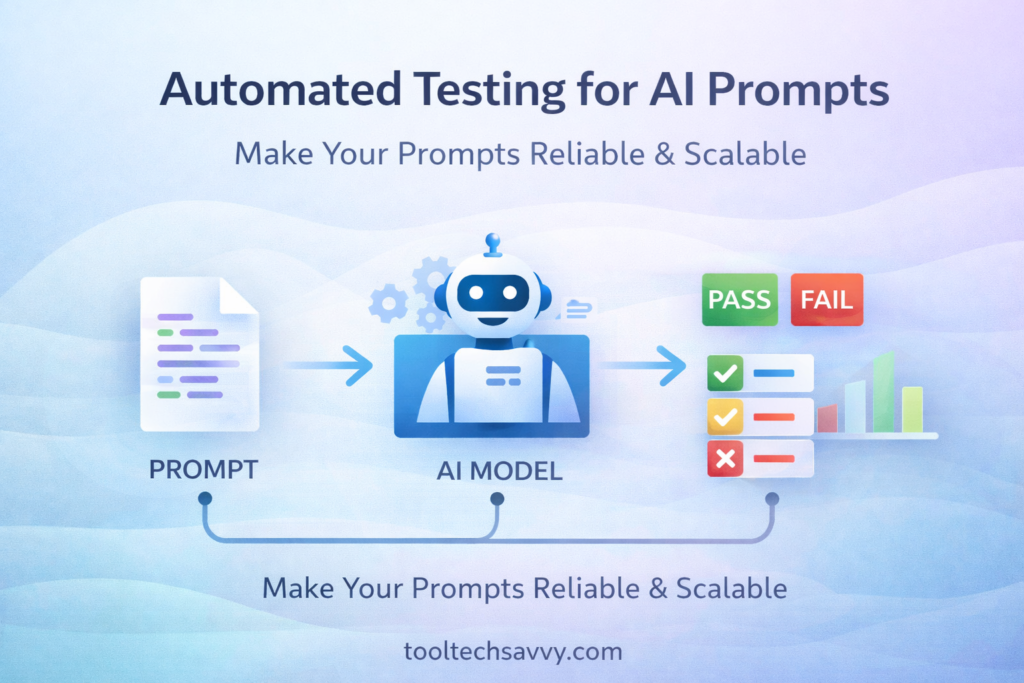
How to Set Up Automated Testing for Your AI Prompts

AI prompts are no longer just experiments—they’re becoming core infrastructure for products, workflows, and automation systems. Yet, while developers rigorously test code, prompts are often shipped without any structured testing at all. That gap creates risk. In this guide, we’ll break down how to set up automated testing for your AI prompts, why it matters, […]

How to Set Up Automated Testing for Your AI Prompts Read More »

How AI Code Review Bots Work (And How to Build One)

Code reviews are essential—but they’re also time-consuming. As repositories grow and teams move faster, manual reviews often become bottlenecks. That’s exactly why AI-powered code review bots are becoming a must-have for modern development teams. In this guide, we’ll walk through how to create an AI code review bot for your GitHub repositories, what tools you

How AI Code Review Bots Work (And How to Build One) Read More »

Google Colab vs Anaconda: A Complete Comparison for New Developers

If you’re starting your journey into Python, data science, or AI, chances are you’ve heard about Anaconda and Google Colab. At first glance, both seem to solve the same problem—running Python code easily. However, once you dig deeper, their use cases, strengths, and limitations become very different. In this guide, we’ll break down Anaconda vs

Google Colab vs Anaconda: A Complete Comparison for New Developers Read More »

Token Economics: Calculating and Optimizing Your AI Costs

AI feels cheap—until it isn’t. Many teams enthusiastically adopt AI tools, only to discover unexpected bills a few weeks later. The culprit isn’t always the model itself. More often, it’s a lack of understanding of token economics—how AI systems actually price computation. In this guide, we’ll break down how token-based pricing works, how to calculate

Token Economics: Calculating and Optimizing Your AI Costs Read More »

How to Monitor AI Performance: Key Metrics Explained

Building an AI system is only half the job. The real challenge begins after deployment, when models face unpredictable inputs, changing user behavior, and real-world constraints. Yet many teams still track the wrong signals—accuracy scores in isolation, vanity metrics, or dashboards that don’t reflect reality. In this guide, we’ll break down which AI performance metrics

How to Monitor AI Performance: Key Metrics Explained Read More »

What Is Multi-Agent Prompting? Coordinating Multiple AI Models Made Simple

AI is no longer a solo act. While single-model prompts work for basic tasks, today’s most powerful AI systems rely on multiple models working together—each with a clear role, responsibility, and objective. This approach is known as multi-agent prompting, and it’s quickly becoming the backbone of advanced AI workflows. In this guide, we’ll break down

What Is Multi-Agent Prompting? Coordinating Multiple AI Models Made Simple Read More »

How to Build a Multi-Document Research Assistant (Step-by-Step)

Research today is broken. Information is scattered across PDFs, docs, web pages, and notes—and jumping between them kills focus. As a result, even powerful AI tools often fail when you ask questions across multiple documents. That’s where a multi-document research assistant changes everything. In this guide, you’ll learn how to build an AI assistant that

How to Build a Multi-Document Research Assistant (Step-by-Step) Read More »

Synthetic Data Generation: Training Models with AI-Created Data

Training AI models has always depended on one thing more than algorithms: data. However, as privacy laws tighten, real-world data becomes harder to access, and edge cases remain rare, a new approach is taking centre stage—synthetic data generation. Instead of collecting more human data, organizations are now creating data with AI to train AI. This

Synthetic Data Generation: Training Models with AI-Created Data Read More »

Understanding Attention Mechanisms: The Heart of Transformers

Transformers didn’t become the foundation of modern AI because they’re mysterious—they won because they’re efficient at focusing on what matters. That “focus” is powered by a concept called attention. If you’ve ever wondered how models like ChatGPT keep track of context, connect ideas across a paragraph, or “choose” which words matter most, this is the

Understanding Attention Mechanisms: The Heart of Transformers Read More »