Must Read

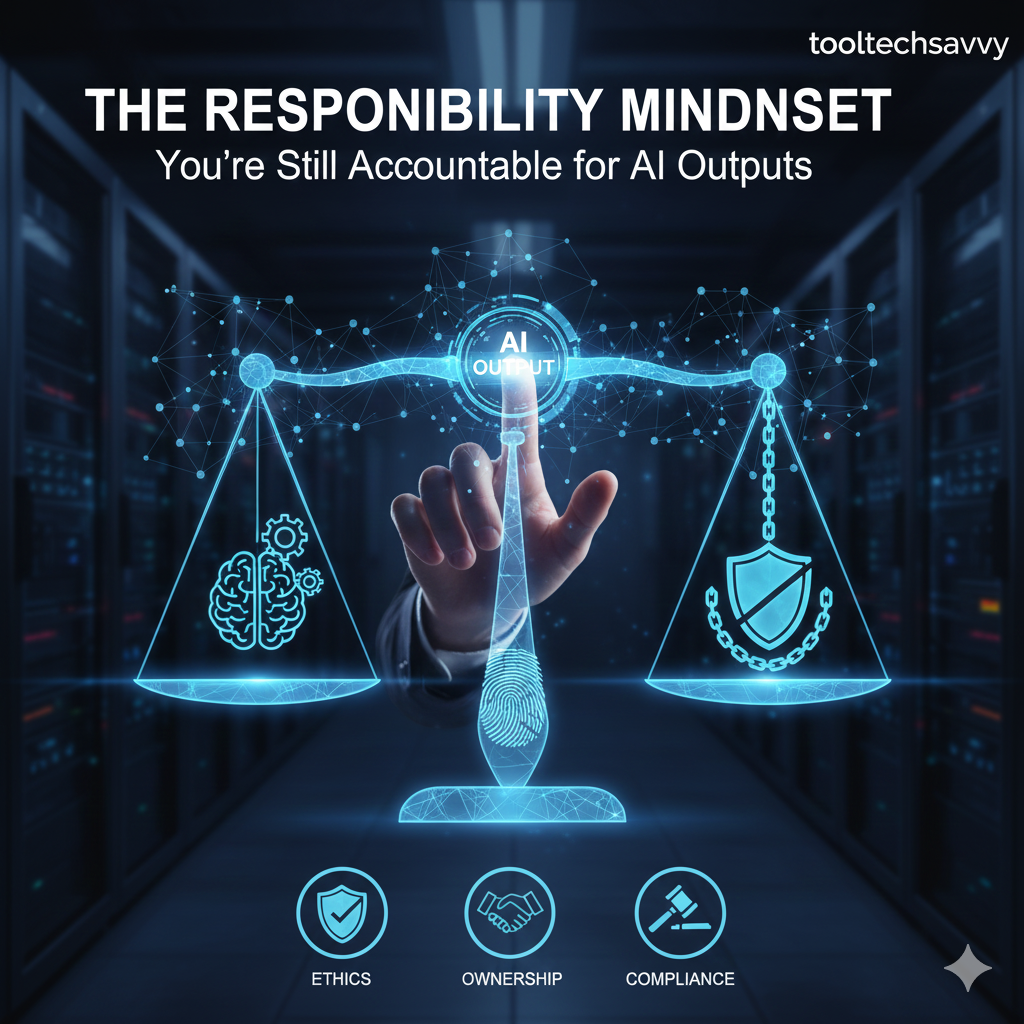
The Responsibility Mindset: You’re Still Accountable for AI Outputs

AI tools have transformed how we write, code, research, and create. But as LLMs become deeply embedded in our workflows, one truth becomes impossible to ignore: you are still responsible for everything your AI produces.This shift—from passive user to accountable operator—is what I call The Responsibility Mindset. It’s not enough to rely on models for […]

The Responsibility Mindset: You’re Still Accountable for AI Outputs Read More »

Jailbreak Prevention: Designing Prompts with Built-In Safety

Large Language Models (LLMs) are powerful—sometimes too powerful when users intentionally (or accidentally) push them outside intended boundaries. This is where jailbreak prevention becomes essential. Instead of relying only on external filters, we can design prompts with built-in safety that reduce risk, strengthen model alignment, and improve reliability. As AI becomes more embedded in workflows—from

Jailbreak Prevention: Designing Prompts with Built-In Safety Read More »

How Security Researchers Red Team AI: A Guide to Model Testing

As AI systems become more capable—and more deeply integrated into search, automation, education, and enterprise workflows—AI safety and security testing have become critical priorities. One method stands out as the backbone of model evaluation: red teaming. Inspired by cybersecurity and military strategy, red teaming involves deliberately pushing AI systems to their limits—finding weaknesses before real-world

How Security Researchers Red Team AI: A Guide to Model Testing Read More »

Understanding AI Hallucinations: Why AI Makes Things Up

As AI systems become part of everything—from writing tools to search engines—one concern keeps resurfacing: AI hallucinations. These moments when an AI confidently generates false information aren’t just technical glitches; they reveal how large language models (LLMs) actually work under the hood. For creators, developers, and everyday users, understanding hallucinations isn’t optional. It’s the difference

Understanding AI Hallucinations: Why AI Makes Things Up Read More »

How to Build an AI-Powered Email Assistant From Scratch (Free & Beginner-Friendly)

If you’ve ever wished you had a personal email assistant—one that sorts, summarizes, drafts, and replies automatically—you’re not alone. Email overload is one of the biggest productivity killers. The good news? With today’s free AI tools, you can build your own AI-powered email assistant from scratch, without coding or spending a single dollar. This guide

How to Build an AI-Powered Email Assistant From Scratch (Free & Beginner-Friendly) Read More »

Context Management in AI: 8 Smart Strategies for Long Conversations

One of the biggest misconceptions about AI tools like ChatGPT, Claude, or Gemini is that they always remember everything. But as every advanced user eventually discovers, AI doesn’t actually “remember”—it processes context. And that context can quickly overflow, disappear, or become inconsistent if not managed strategically. Whether you’re building workflows, developing agents, or working on

Context Management in AI: 8 Smart Strategies for Long Conversations Read More »

The Ultimate Agentic AI Framework Comparison: LangGraph, AutoGen, and CrewAI

The world of AI is shifting dramatically from “chat assistants” to agentic AI systems—AI that can plan, reason, take actions, and coordinate with other agents. If tools like ChatGPT revolutionized interaction, agentic frameworks are revolutionizing autonomy. Three of the most influential frameworks today are: Each takes a different approach to building AI agents, designing workflows,

The Ultimate Agentic AI Framework Comparison: LangGraph, AutoGen, and CrewAI Read More »

Why Multimodal AI Is the Next Big Leap—CLIP & LLaVA Breakdown

For years, AI systems treated text and images as separate worlds. Text models could read. Vision models could see. But neither could understand both at once. That changed with the emergence of vision-language models—powerful multimodal systems like CLIP, LLaVA, and today’s increasingly intelligent all-in-one AI models. These new systems can analyze an image, interpret its

Why Multimodal AI Is the Next Big Leap—CLIP & LLaVA Breakdown Read More »

Understanding Model Parameters: 7B, 13B, 70B – What Do They Mean?

As AI models continue to shape how we work, create, and code, you’ll often see terms like 7B, 13B, or 70B included in model names. These numbers refer to the number of parameters—the internal “weights” a model uses to learn patterns and generate responses. But what do these parameter sizes actually mean for everyday users?

Understanding Model Parameters: 7B, 13B, 70B – What Do They Mean? Read More »