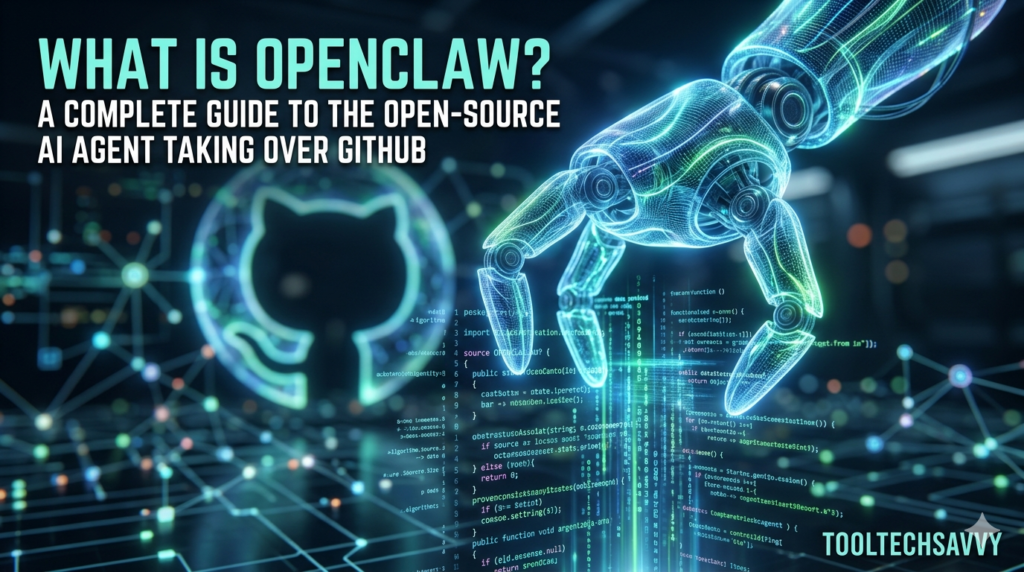
OpenClaw is a free, open-source AI agent that runs directly on your machine. Unlike the AI tools you’re used to — where you type a question and get a reply — OpenClaw doesn’t just respond. It acts. It can read and write files, run shell commands, control your browser, manage your email and calendar, and execute multi-step workflows, all triggered by a simple message in WhatsApp, Telegram, Discord, Slack, or whatever chat app you already use.
Think of it less as a chatbot and more as a capable assistant parked at a desk with your keyboard and mouse — one you can text from anywhere and who’ll quietly get things done while you’re away.
OpenClaw was first published in November 2025 by Austrian developer Peter Steinberger under the name Clawdbot, itself derived from an earlier personal tool he’d built called Clawd (a nod to Anthropic’s Claude). After a trademark dispute and two rebrands — first to Moltbot in January 2026, then to OpenClaw three days later — the project landed on its current name. The name stuck, and so did the community: within weeks, the repository had racked up hundreds of thousands of GitHub stars, making it one of the fastest-growing open-source AI projects in history.
Created by: Peter Steinberger (PSPDFKit founder)
License: MIT (fully open-source)
Supported OS: macOS, Windows (via WSL2), Linux
GitHub Stars: 310,000+ (as of May 2026)
Supported AI Models: Anthropic Claude, OpenAI GPT, Google Gemini, DeepSeek, local models via Ollama
Cost: Free to install; you pay only for AI model API usage (typically $10–70/month for typical use)
How It’s Different from ChatGPT or Claude.ai
Standard AI interfaces operate in a request-response loop: you prompt, they reply, the transaction ends. OpenClaw is built to run continuously in the background, execute multi-step workflows, and make decisions autonomously without checking in with you at every turn. A single task typically triggers three to eight LLM calls under the hood. The result feels less like using software and more like delegating to a capable colleague who just gets on with it.
Crucially, everything stays on your hardware. Your files, context, and memory are stored locally as plain Markdown files — not on someone else’s servers.
Core Architecture: How OpenClaw Works
OpenClaw is built around a concept called the Gateway — a local process that acts as a control plane connecting your AI model, your messaging channels, your local machine, and any skills you’ve installed.
| Component | What It Does |
|---|---|
| Gateway | The core daemon that runs locally and orchestrates everything — connects AI models to channels and tools. |
| Channels | The messaging apps you use to talk to your agent: WhatsApp, Telegram, Discord, Slack, iMessage, Signal, Teams, and more. |
| Skills | Modular capability packs stored as directories with a SKILL.md file. Think of them as plugins — everything from GitHub integration to browser automation. |
| Memory | Persistent context stored as Markdown files on your disk. Your agent remembers your preferences, prior tasks, and long-term context across sessions. |
| Heartbeat / Cron | A scheduler that wakes the agent at configurable intervals so it can run proactively — no message required from you. |
Skills can be bundled with OpenClaw, installed globally, or scoped to a specific workspace. Workspace-level skills take precedence, giving you fine-grained control over what your agent can do in different contexts. The community skill registry, ClawHub, lists hundreds of contributed skills ranging from CRM integrations to smart home control.
How to Set Up OpenClaw
The official recommended setup path is the openclaw onboard command, which walks you through everything in a single guided session. Here’s how to get from zero to a running agent.
Prerequisites
Node.js: v24 (recommended) or v22.16+ at minimum. Check with node --version.
Package manager: npm, pnpm, or bun — any will work.
AI API key: From Anthropic, OpenAI, or Google. OpenClaw is model-agnostic; you bring your own key.
Windows users: WSL2 is strongly recommended. Native Windows support exists but WSL2 gives the smoothest experience.
Step-by-Step Setup
-
1Install OpenClaw globally Use npm or pnpm to install the CLI:Terminal
Verify the install succeeded:# Using npm npm install -g openclaw@latest # Using pnpm pnpm add -g openclaw@latestTerminalopenclaw --version -
2Run the guided onboard wizard This single command configures your gateway, connects your AI model, sets up your workspace, and installs the background daemon all at once:Terminal
Theopenclaw onboard --install-daemon--install-daemonflag installs OpenClaw as a persistent background service (via launchd on macOS, systemd on Linux) so it keeps running even when your terminal is closed. This is the key step that most guides bury or skip — a successful install is not a successful setup. The onboard wizard is where OpenClaw becomes actually usable. -
3Enter your AI model API key During onboarding, you’ll be prompted to choose a provider and paste your API key. For most users, Claude Sonnet 4.6 via Anthropic is the recommended default — strong cost-to-capability ratio for general tasks. If you need maximum reasoning power, Opus 4.6 is one step up.config.yaml (example)
Security note: Treat your config file like any other secrets file. Never commit it to version control.model: provider: anthropic primary: claude-sonnet-4-6 api_key: sk-ant-xxxxxxxxxxxxxxxx -
4Connect a messaging channel Onboarding will prompt you to pair at least one channel. Telegram is the easiest for first-timers — you simply create a bot via
@BotFatheron Telegram, paste in the bot token, and you’re live. For WhatsApp and iMessage, you scan a QR code.Supported channels include WhatsApp, Telegram, Slack, Discord, iMessage, Signal, Google Chat, Microsoft Teams, Matrix, LINE, WeChat, and many more.
-
5Open the Control UI and say hello Once onboarding completes, OpenClaw opens a browser dashboard at
http://localhost:3000. You can chat there directly, or — better — open your connected messaging app and send your agent a message. It should respond.Your first message (Telegram / WhatsApp / Discord)
Your agent will introduce itself and explain what’s available based on your installed skills.Hey, what can you help me with? -
6Browse and install skills from ClawHub Skills are how you extend what your agent can do. Browse the community registry at clawhub.io and install anything relevant to your workflow — GitHub, Notion, Google Calendar, browser automation, and hundreds more. Always verify the skill’s source and check its VirusTotal scan before installing, as skills execute code on your machine.Terminal
# Install a skill from ClawHub
openclaw skills install github
openclaw skills install notion
openclaw skills install browser-control
Alternative: Docker Setup
If you’d prefer a sandboxed environment — a good idea for experimenting before granting full system access — Docker is a clean alternative:
# Pull the official image
docker pull openclaw/openclaw:latest

# Run with default settings
docker run -d --name openclaw \
  -p 3000:3000 \
  openclaw/openclaw:latest

# Access the Control UI
# Open: http://localhost:3000
For a production or always-on deployment, DigitalOcean offers a one-click OpenClaw deploy that comes pre-configured with TLS, a reverse proxy, and security-hardened defaults — useful if you want your agent accessible from anywhere without managing server infrastructure yourself.
Getting Started: Your First Tasks
Once OpenClaw is running and connected to a channel, getting started is as simple as having a conversation. The agent interprets natural language and maps it to available tools and skills. A few good tasks to try first:
Day-to-day assistant tasks
# Summarise recent emails from a specific sender
"Summarise everything from alex@company.com in the last 7 days"

# Add a calendar event
"Block 2pm–3pm on Friday for a team review. Add a Zoom link."

# Set a proactive reminder
"Remind me every morning at 8am with a briefing of my calendar and top 3 tasks"

# File management
"Move all PDFs from my Downloads folder into ~/Documents/Invoices and rename them by date"
Developer workflows
# Code review
"Review the open PRs on github.com/myorg/myrepo and summarise what's ready to merge"

# Test runner + error resolution
"Run the test suite for my app, capture any failures, and open PRs with fixes"

# Debugging
"Analyse the last 200 lines of /var/log/app.log and tell me what's causing the spike in errors"
Setting up proactive cron tasks
One of OpenClaw’s most powerful features is its heartbeat scheduler, which lets your agent run tasks on a schedule without any message from you:
# In a message to your agent:
"Every weekday at 7:45am, check my calendar for today,
 pull my top 3 open GitHub issues, and send me a morning briefing"

# Or in your config:
cron:
  - schedule: "45 7 * * 1-5"
    task: "morning_briefing"
What Can You Do with OpenClaw?
This is where things get genuinely compelling. The range of real-world use cases already documented by the community is broad — here are the most impactful categories.
Developer Automation
Manage Claude Code or Codex sessions, auto-run tests, capture Sentry errors, and open fix PRs — all without touching your machine. Effectively a senior developer on call 24/7.
Email & Calendar Management
Draft replies, summarise inboxes, schedule meetings, and handle health or travel reimbursements — all by text message from your phone.
Browser Automation
Fill forms, extract website data, scrape competitor pricing, and interact with any web UI. One user’s agent negotiated $4,200 off a car purchase overnight by playing dealers against each other via email.
File & System Management
Read, write, organise, and transform files. Run shell scripts. Build ETL pipelines that connect multiple data sources and handle schema migrations automatically.
Research & Lead Generation
Small businesses use OpenClaw to automate prospect research, audit competitor websites, and push qualified leads directly into CRM systems — with no human in the loop.
Proactive Monitoring
Set it to check flight statuses, monitor a stock portfolio, watch a GitHub repo for new releases, or alert you when a website goes down — all via push notification to your phone.
Smart Home & IoT
With the right skills installed, OpenClaw can interface with smart home devices, voice assistants, and even camera feeds — community members have built automations like “take a photo of the sky when it’s pretty.”
Multi-Agent Workflows
Run multiple OpenClaw instances where one agent plans, others execute specialised subtasks, and results are automatically compiled. Enabled by Moltbook, a social layer for AI agents to interact with one another.
Security: What You Need to Know
OpenClaw can be given broad access to your machine — file system, shell, browser, email, calendar. That’s exactly what makes it powerful, and exactly what makes understanding the security model important.
The level of autonomy is configurable. You might allow email reads but require approval before sends, or permit file reads but block deletions. Disable those guardrails and the agent executes without asking. Start conservative and expand access as you gain trust in how your setup behaves.
Prompt injection — where malicious content in a web page or document tricks the agent into taking unintended actions — remains an unsolved industry-wide problem. Use strong, up-to-date models and review OpenClaw’s security best practices before deploying in sensitive environments.
When installing community skills from ClawHub, always verify the author and check the VirusTotal scan. Treat skills as code you are responsible for reviewing before it runs on your machine.
The MIT licence and fully auditable codebase are genuine strengths here. Unlike closed-source agents, you can read every layer of how OpenClaw works, inspect what a skill does before installing it, and fork the project to meet your organisation’s requirements. NVIDIA has contributed hardened security defaults through its NemoClaw reference implementation for enterprise deployments.
How Much Does It Cost?
OpenClaw itself is completely free. Your only costs come from AI model API usage. Here’s a rough guide:
| Usage Level | Typical Monthly API Cost | Best Fit For |
|---|---|---|
| Light use | $10 – $30 | Daily briefings, occasional automation tasks |
| Typical use | $30 – $70 | Developer workflows, email management, research tasks |
| Heavy automation | $100 – $150+ | Always-on agents, multi-step pipeline automation, background cron tasks |
You can reduce costs significantly by routing lighter tasks through local models via Ollama, or using OpenRouter to mix providers and models within a single setup.
Where Is OpenClaw Headed?
The project’s trajectory has been extraordinary. After Steinberger announced he was joining OpenAI in February 2026, a non-profit foundation was established to provide independent stewardship going forward. The open-source model has spawned a growing ecosystem: enterprise variants (NVIDIA’s NemoClaw), Chinese deployments on WeChat and DeepSeek, Microsoft’s internal ClawPilot project, and hundreds of community-built skills and deployment guides.
What OpenClaw represents is a broader shift in AI — from tools that respond to tools that act. The gap between “what you can imagine” and “what actually gets done” is narrowing fast, and OpenClaw is one of the clearest examples of where autonomous AI is heading.
Quick-Start Cheatsheet
# 1. Install
npm install -g openclaw@latest

# 2. Onboard (configure + install daemon)
openclaw onboard --install-daemon

# 3. Check status
openclaw status

# 4. View logs if something goes wrong
openclaw daemon logs

# 5. Install a skill
openclaw skills install github

# 6. Update OpenClaw
npm install -g openclaw@latestGitHub: github.com/openclaw/openclaw
Official docs: docs.openclaw.ai
Skill registry: clawhub.io
Discord community: Available via openclaw.ai
DigitalOcean 1-click deploy: digitalocean.com
ToolTechSavvy covers the AI tools, cloud platforms, and developer workflows that actually matter — written for practitioners, not just observers.
Read More at ToolTechSavvy →