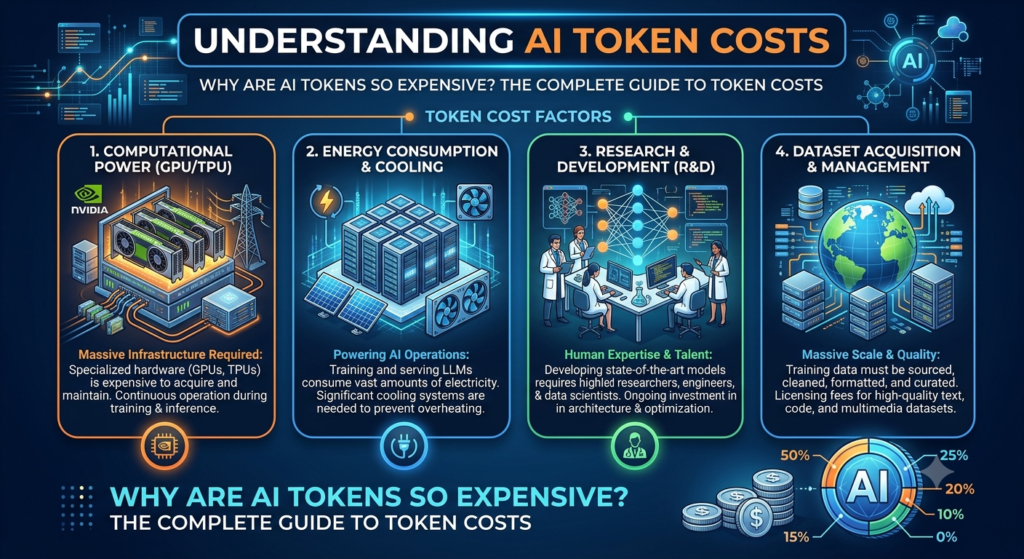
Every developer who has wired an app up to a model API eventually hits the same moment of sticker shock: a single long conversation, a handful of tool calls, a document dumped into context — and the bill jumps in a way that feels disproportionate to what actually happened. To understand why, it helps to stop thinking about tokens as “words” and start thinking about them as units of compute that get progressively more expensive the more of them you accumulate in a single request.
A token is not a word, it’s a unit of work
A token is roughly three to four characters of text — sometimes a whole word, sometimes a fragment, sometimes a single punctuation mark. That part is well known. What’s less obvious is what happens to that token once it enters the model. Every token has to pass through every layer of the network, and at each layer it interacts, via the attention mechanism, with every other token that came before it in the sequence.
That interaction is the crux of the cost problem. Self-attention scales roughly with the square of the sequence length. Double the number of tokens in your context, and you don’t double the compute — you roughly quadruple it for the attention component alone. A 500-token prompt and a 50,000-token prompt are not the same task scaled up linearly; they are qualitatively different amounts of work for the hardware.
Where the money actually goes: GPUs, memory, and the KV cache
Running a large model is not like running a typical web service. The model’s weights — often hundreds of gigabytes for frontier models — have to sit in high-bandwidth GPU memory, and every single token generated requires a full pass through that entire weight set. This is why inference is described as memory-bandwidth bound rather than purely compute bound: the bottleneck is often how fast data can move between memory and processing cores, not the raw arithmetic.
Then there’s the KV cache — the key/value tensors the model stores for every token in the context so it doesn’t have to recompute attention from scratch on each new token. That cache grows linearly with context length and has to live in the same scarce GPU memory as the model weights. A long conversation or a big pasted document doesn’t just cost compute to process once; it occupies memory for the entire duration of the request, competing with every other request the provider is trying to serve on that same hardware.
This is the real reason providers price input tokens by context position and often price output tokens several times higher than input tokens. Generating a token requires a full forward pass plus a KV cache write; simply reading an input token is comparatively cheaper because it can be processed in parallel with the rest of the prompt in a single batched pass.
Why output tokens cost more than input tokens
If you’ve looked at any provider’s pricing page, you’ll notice output tokens are almost always priced at three to five times the rate of input tokens. This isn’t arbitrary margin-stacking — it reflects a genuine architectural asymmetry:
- Input processing is parallel. The entire prompt can be fed through the model in one batched pass, so the GPU can process thousands of input tokens at close to full utilization.
- Output generation is sequential. Each new token depends on every token generated before it. The model can’t generate token 500 until it has produced token 499, which means output generation is inherently a one-token-at-a-time loop, with all the latency and underutilization that implies.
- Sequential generation is harder to batch efficiently. Providers use tricks like continuous batching and speculative decoding to claw back throughput, but the fundamental serial dependency remains, so output tokens simply cost more compute-seconds to produce.
The context window tax
Here’s the part that catches most engineering teams off guard: cost isn’t just a function of how many tokens you send in a single message — it’s a function of how many tokens the model has to attend over for every subsequent token, including ones you didn’t explicitly write. System prompts, tool definitions, retrieved documents, prior turns in a conversation, and even the model’s own previous responses all sit in context and get re-processed (or re-attended to) on every turn.
This is why a chatbot that has been running for forty turns costs meaningfully more per message than the same chatbot on turn one, even if the person’s actual question is a single short sentence both times. The accumulated history is the expensive part, not the new input.
| Cost driver | What increases it | Why it matters |
|---|---|---|
| Context length | Long documents, chat history, tool schemas | Attention cost grows superlinearly with sequence length |
| Output length | Verbose responses, chain-of-thought, code generation | Sequential generation is compute-per-token expensive and hard to parallelize |
| Model size | Parameter count of the model you select | Bigger weight matrices mean more memory bandwidth per token |
| Concurrency | Number of simultaneous requests on shared hardware | KV cache memory is finite and shared across users |
Model size is still the biggest lever
Beyond context length, the single biggest driver of per-token cost is which model you’re actually calling. Larger models have more parameters, which means more matrix multiplications per token and more memory bandwidth consumed moving those weights around. This is exactly why providers offer a tiered lineup — smaller, cheaper, faster models for routine tasks, and larger, more expensive models reserved for work that genuinely needs the extra reasoning capacity. Routing simple classification or extraction tasks to a small model instead of a flagship one is often the single highest-leverage cost optimization available to a team.
Practical ways to keep token costs under control
- Trim context aggressively. Summarize or prune old conversation turns instead of replaying the full history on every call.
- Match the model to the task. Use a smaller, faster model for routing, extraction, and simple formatting; reserve the largest model for genuinely hard reasoning.
- Cache and reuse. Many providers offer prompt caching for repeated system prompts or reference documents — this can cut input costs substantially for stable content.
- Constrain output length explicitly. Ask for concise answers or set max-token limits where verbosity isn’t adding value, since output tokens are the most expensive per-unit cost.
- Batch where latency isn’t critical. Asynchronous batch processing is typically discounted because it lets providers schedule work more efficiently against available capacity.
The token is the invoice line item. The real cost is memory bandwidth, sequential compute, and a cache that never stops growing.
The takeaway
Token pricing looks like a simple per-word tax, but underneath it’s a proxy for genuinely scarce resources: GPU memory bandwidth, the size of the KV cache a request occupies, and the strictly sequential nature of generating new text. Once you see tokens this way, cost optimization stops being about writing shorter prompts for the sake of it, and starts being about managing context deliberately, picking the right-sized model for the job, and treating every additional turn in a conversation as a small, compounding tax on everything that follows.
If this kind of under-the-hood breakdown is useful, there’s more where it came from — dig into the rest of the AI and developer tooling posts on ToolTechSavvy for practical guides on Claude Code, MCP integrations, agentic workflows, and cloud developer tooling.
Explore tooltechsavvy.com →